




A night at the movies, inside and outside the screen.
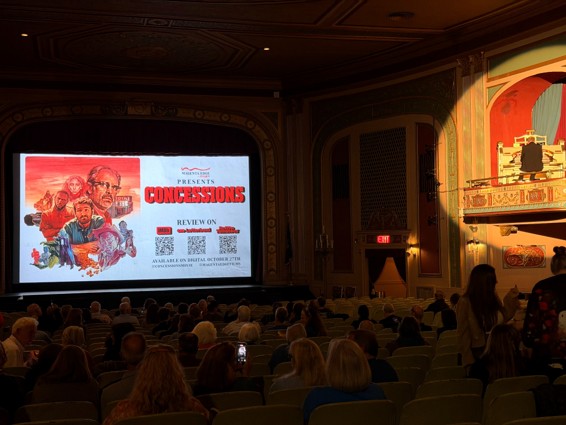
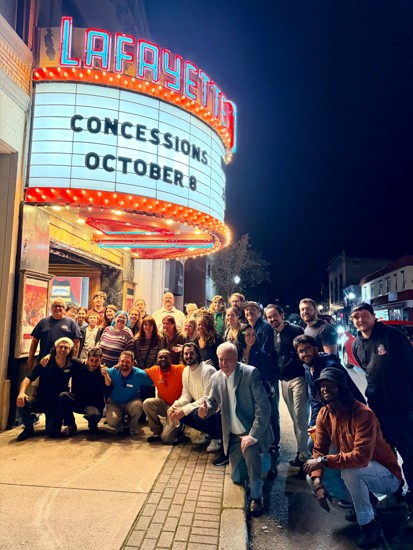
On Thursday evening, October 8, Suffern’s historic Lafayette Theatre welcomed a packed audience for a homecoming screening of Concessions, an independent comedy-drama written and directed by Mas Bouzidi.
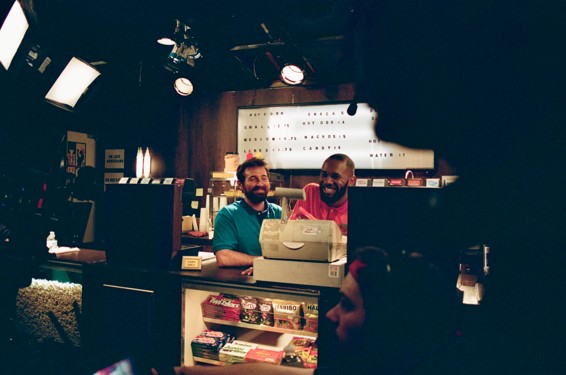
The film follows the final day of the fictional Royal Alamo Cinema in Albany, New York. It was filmed primarily at the Lafayette, making this a particularly fitting place for cast members, filmmakers, local extras and moviegoers to gather.
Following a sold-out New York premiere, Concessions returned to the theater where much of its story had been brought to life.
The evening featured a performance on the Lafayette’s historic Wurlitzer organ, the screening, and a post-film question-and-answer session with the director and cast, moderated by Ari Benmosche. The audience included people who traveled to Suffern as well as local residents who appeared in the film.
A Theater With Its Own Story
The Lafayette Theatre opened on March 3, 1924. Designed by architect Eugene De Rosa, it welcomed audiences for silent films and vaudeville long before television, multiplexes and streaming changed how people watched movies.
In 2001, Robert Benmosche purchased the property and invested in preserving the theater. His son, Ari Benmosche, took over its operations in 2013. That family connection helps explain why a movie about the possible disappearance of a neighborhood cinema would strike so close to home here. Suffern Mayor Michael Curley has previously expressed his gratitude for Robert Benmosche’s role in saving the Lafayette. His appreciation reflects a larger point: it takes a village to preserve a landmark like this.
An Invitation I Couldn’t Refuse
When Ari Benmosche invited me to cover the screening, I didn’t have to think long about accepting. I’ve always appreciated historic theaters, whether it’s a Broadway theater in Manhattan, the Apollo in Harlem, or the Lafayette in Suffern.
I arrived in Suffern by bus after finishing another part-time job. I had already eaten, but deliberately skipped dessert. I knew I was going to the movies, and that meant popcorn.
As soon as I entered the Lafayette, the familiar smell of popcorn greeted me. But this wasn’t an ordinary multiplex: the décor, the auditorium and the sense of history made the visit an experience before the film even began.
The People Behind the Theater
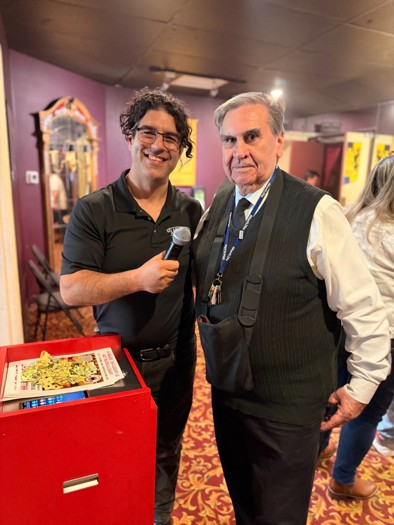
One of the first people I spoke with was Franco, the Lafayette’s longtime doorman. Dressed in his traditional theater uniform, he looked like someone who belonged in a movie palace from another era.
Franco has worked at the Lafayette since Ari took over operations. We talked about how much moviegoing has changed. With only one screen, he explained, attendance depends on which movie is playing. He has nevertheless enjoyed working with Ari and being part of the theater.
At the concession stand, I met Milo, a 19-year-old who spoke warmly about his connection to the village and the Lafayette. He referred to it as “our theater” and expressed his appreciation for the arts. His sense of pride in this local landmark was clear.
Inside the auditorium, I spoke with Peter, a regular who comes a couple of times a month. Our conversation turned to other historic movie palaces, including Loew’s 175th Street Theatre in Manhattan and Loew’s Paradise Theatre in the Bronx. Peter described the Lafayette as a beautiful theater and a wonderful experience. Like me, he appreciates the atmosphere of old movie palaces.
In the lobby, I also spoke with Mas Bouzidi, the young writer and director of Concessions. Bouzidi told me he spent much of his teenage years working at Regal cinemas in the Albany area. After moving to New York City to study at NYU, he also worked at Film Forum, the well-known Manhattan art house. Experiencing both multiplexes and art-house theaters helped inspire his story about a cinema’s last day.
He said, “I got the multiplex experience growing up and then more of the art-house city experience.” Bouzidi also told me that those experiences, along with theater closures during COVID-19, made him want to make a movie about a movie theater closing. He spoke about the dramatic possibilities of a last-day hangout movie, mentioning Dazed and Confused and American Graffiti. Before we parted, he added, “Wait till you see this movie. I think you’re going to love it!”
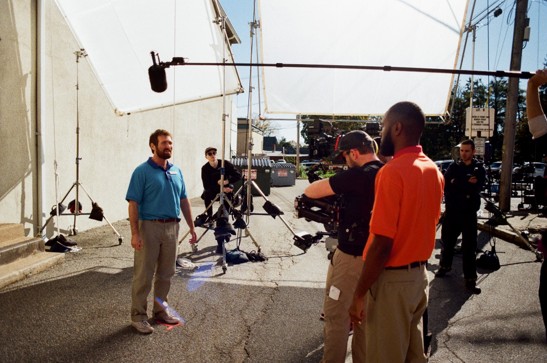
Bouzidi’s affection for movie theaters also shapes the film’s appearance. He shot Concessions on 16mm, seeking the grainy, handmade quality of independent films from the 1990s. A 35mm print was prepared for its theatrical roadshow. Having worked in cinemas for years, he wanted to tell a story about the people behind the counter and behind the scenes, and what a neighborhood loses when a theater closes.
A Little Music Before the Movies
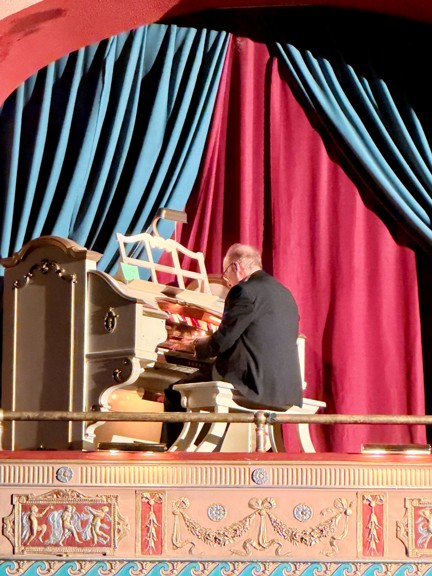
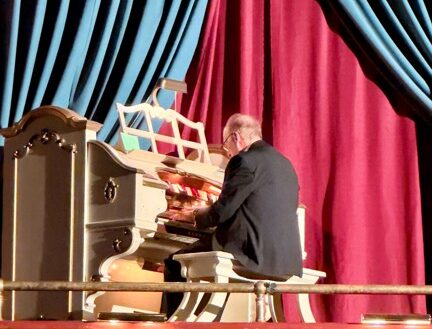
At 6:30 p.m., organist Dave Kopp entertained arriving moviegoers on the Lafayette’s Ben Hall Memorial Wurlitzer organ. The illuminated console and elaborate surroundings offered something different from the usual multiplex experience.
Before the film, Bouzidi and members of the cast spoke about returning to the place where they had spent so much time making it. Their remarks carried a sense of emotion: coming back felt like a homecoming.
Ari also addressed the audience, thanking those who helped make the production possible. He said the evening was made possible by donations and support from the Village of Suffern. He also acknowledged Mayor Michael Curley, who was in the crowd, and thanked him for his support. It was another reminder of how much this theater means to the community.
Ari Benmosche described seeing the film at the Lafayette as especially personal: “It felt very close to home, surreal, and a terrific satire in many ways of our life at the Lafayette.”
The audience greeted the start of the film with enthusiastic applause. Then the lights went down.
The Movie: Concessions
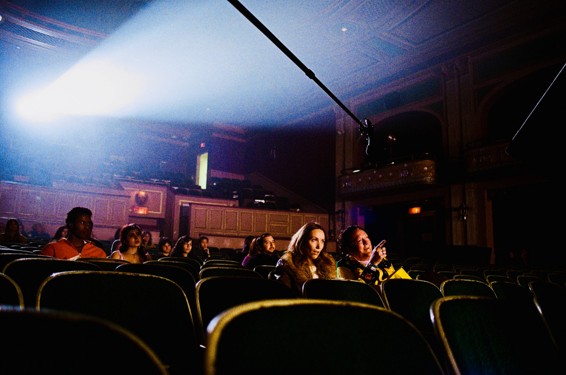
One of the most magical parts of watching Concessions was recognizing corners of the Lafayette on the screen while sitting in that very building.
The fictional Royal Alamo Cinema is preparing to close. Its employees and customers spend the final day arguing, joking, remembering and wondering what comes next. The film mixes comedy with more serious questions about disappointment, belonging and the places people grow attached to.
The central ensemble deserves more attention than a simple cast list. Rob Riordan plays Hunter and Jonathan Lorenzo Price plays Lorenzo, two of the employees whose conversations and conflicts help carry the film. Steven Ogg portrays Luke Plimpton, the man in charge of the struggling cinema, while Lana Rockwell plays Deana, another worker facing the theater’s uncertain future.
Michael Madsen appears in a smaller supporting role as Rex Fuel, a former Hollywood stuntman visiting the cinema to revisit his past. His presence is especially poignant because Concessions was among his final films before his death in 2025. In an interview with Hammer to Nail, Bouzidi said that Madsen brought a sadness and sensitivity to Rex that went beyond the original script: “I think there’s a lot of Michael in Rex.”
Almost everyone in the film seems to be searching for something—recognition, acceptance, a second chance or simply a place to belong. The film also has the spirit of hangout movies such as American Graffiti and Dazed and Confused, even if its characters don’t always find common ground.
When the film began, my first impression was that it seemed a little unpolished. Some performances were uneven, and a few scenes didn’t flow as smoothly as I expected. At first, I saw those as flaws. But the longer I watched, the more I realized this wasn’t supposed to be a polished Hollywood production. The imperfections made the characters seem more like ordinary people, with awkward conversations, frustrations and problems of their own. I still noticed the uneven moments, but I began to appreciate how those rough edges gave the film a sense of reality.
Bouzidi shot Concessions entirely on 16mm film. In the interview for Hammer to Nail, he described the texture he wanted as “tactile, organic and handmade.” That grainy look was intentional. I wouldn’t say the uneven performances were necessarily intentional, but together with the film’s smaller-scale atmosphere, they contributed to the feeling that I was watching real people with real frustrations.
I admired Bouzidi’s ambition. The film is imaginative, sometimes funny and occasionally moving. It doesn’t always come together neatly. This style of creativity is what makes Concessions unique.
Mas told me in our lobby interview before the film began, “I don’t think a film like this has ever been made.”
You know what, Mas? I agree.
When the Audience Becomes Part of the Story
What made this screening especially interesting was the audience itself: longtime moviegoers, local residents, out-of-town visitors and some people who had participated in the production as extras.
There was something magical about watching a fictional theater face its final day inside a real movie palace that has survived more than a century. The Lafayette’s history was already part of this story before the first frame appeared.
When the film ended, the audience responded with another round of enthusiastic applause. I wondered how many people in that room had memories of their first movie, a first date, or an afternoon at the theater with friends and family.
The Memories Remain
Movie theaters come and go. Some survive for generations; others close. But the memories of the films we saw and the people we went with don’t disappear when the lights go out.
On October 8, the fictional Royal Alamo Cinema and the real Lafayette Theatre shared the same screen. And more than a century after opening, the Lafayette was still bringing people together for a night at the movies.