





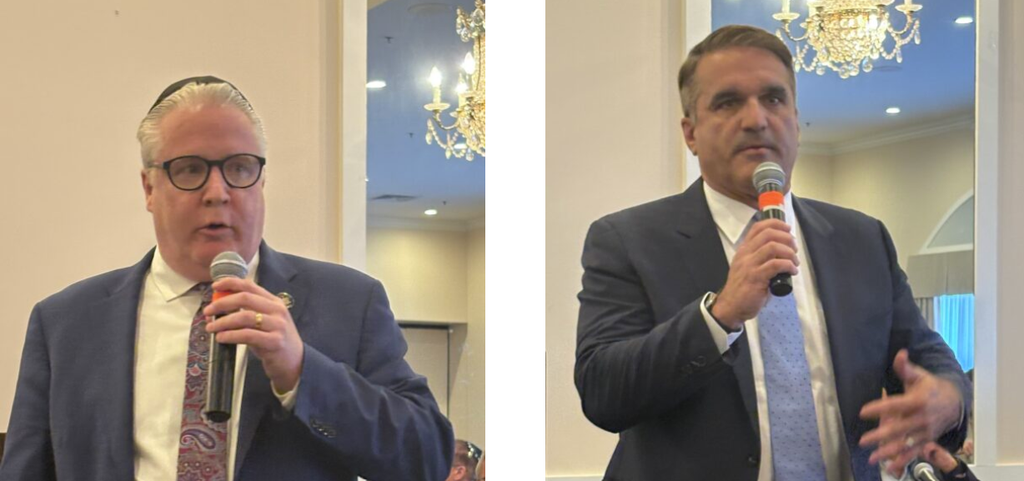
New City, NY — With Election Day just two days away, New York State Senator Bill Weber and Nyack Mayor Joe Rand met Sunday morning, November 1, 2026, at the New City Jewish Center for a debate over the future of New York’s 38th State Senate District. The two candidates discussed state funding, roads, school aid, housing costs, energy policy, immigration enforcement, and their records in public office.
Rockland News recorded the approximately 30-minute audio, and will have the full audio available shortly on WRCR Radio AM 1700. Residents who would like to receive the recording first by email can subscribe to Rockland News for free at https://rocklandnews.com/subscribe/.
The debate was part of a larger “Meet the Candidates” breakfast that began at 9 a.m., following the return to Eastern Standard Time earlier that morning. Other races represented at the event included the 17th Congressional District, the 96th State Assembly District, and Clarkstown Town Supervisor.
The State Senate discussion brought together two Rockland County residents with different political backgrounds and views about how to represent the district in Albany.
Weber, a Republican who was first elected to the State Senate in 2022 and won reelection in 2024, is seeking another term. Rand, a Democrat who serves as mayor of Nyack, is challenging him in the November 3 election.
Throughout the discussion, both candidates described their experience in business and public service. Their largest disagreement involved what a state senator should accomplish and how voters should measure those accomplishments.
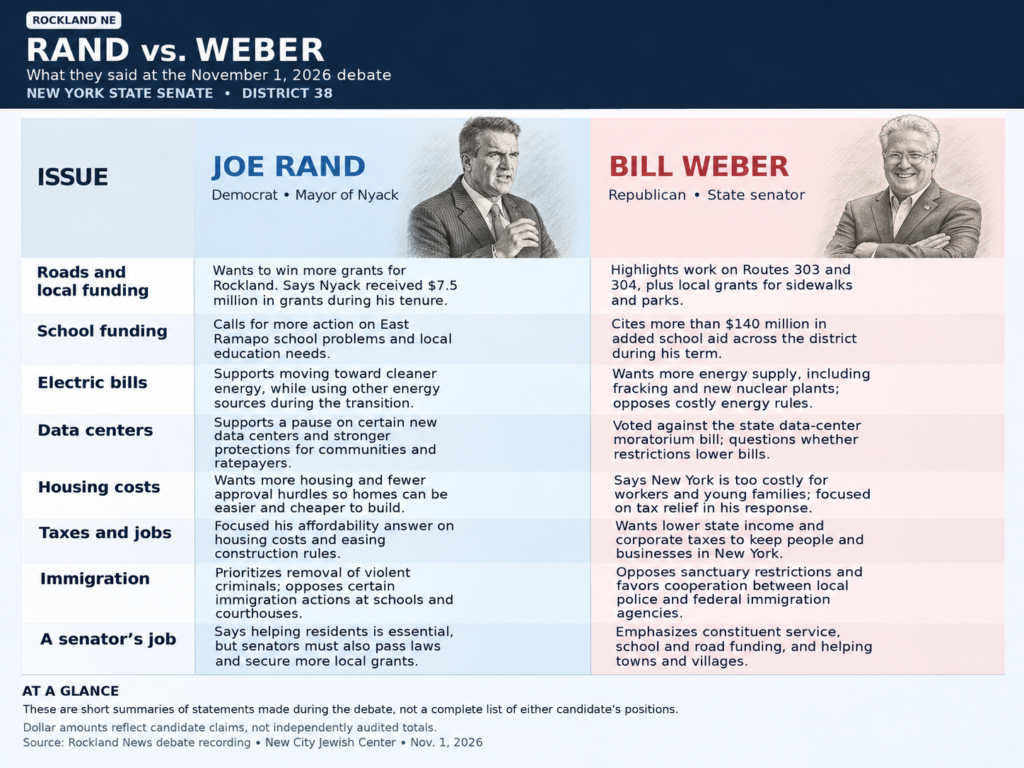
Before we delve into the details, here is a chart detailing each candidate’s viewpoints on issues affecting Rockland County, NY.
Two Candidates With Business and Government Experience
Rand opened by describing his childhood in Rockland County, his education, and his professional background. He attended Georgetown University and Georgetown Law, later pursued graduate legal studies at Stanford, and worked as a law professor before joining his family’s real estate business.
He said he spent approximately 25 years helping build the company before becoming more involved in local government.
Rand previously served on the board of Rockland Community College and became a member of the Nyack Village Board before being elected mayor.
He described his work in Nyack as evidence that he could deliver results at the state level.
Among the accomplishments he discussed was approximately $7.5 million in grants secured for village projects and the establishment of a free electric shuttle bus serving Nyack.
Weber opened by emphasizing his nearly four years representing the district and his office’s work helping residents with government problems.
Before entering the Senate, Weber worked for more than 25 years in the private sector, including serving as chief financial officer for a business involved in golf course and real estate development.
He said his experience working with customers influences how his Senate office handles requests from residents.
According to Weber, his office has closed more than 4,000 constituent cases involving matters such as state tax refunds, Department of Motor Vehicles problems, unemployment benefits, and business licensing.
He described those cases as practical examples of government helping residents solve problems that affect their daily lives.
Weber also pointed to what he described as more than $140 million in additional education funding for schools in his district, along with road improvements and infrastructure investments.
State Funding and Infrastructure Become Major Points of Disagreement
One of the first questions asked both candidates what funding and improvements they had secured for the district and what additional projects they would pursue.
Weber identified infrastructure as one of his major priorities.
He said Rockland County’s population growth has increased traffic, placed greater demands on roads, and created a need for continued state investment.
He specifically mentioned improvements to Routes 303 and 304, two heavily traveled state roads in Clarkstown.
Weber also discussed grants for local municipalities, including approximately $75,000 for sidewalks in Chestnut Ridge and another $75,000 for park improvements in Wesley Hills.
He said school funding remained a priority, noting that his children attended public schools in the Suffern Central School District.
Rand responded by drawing a distinction between funding included in the state budget and grants that local officials actively seek for individual projects.
He argued that some road funding highlighted by Weber resulted from broader state spending plans approved by the Legislature, rather than money secured solely through the senator’s efforts.
Rand said his work in Nyack demonstrated his ability to identify available grants, pursue funding opportunities, and obtain financial assistance for local projects.
He again cited the approximately $7.5 million in grants received by Nyack during his time as mayor.
Rand also discussed an increase in state child care assistance for Rockland County.
He said he worked with educators, nonprofit organizations, and state officials to address problems with the formula used to distribute child care funding.
According to Rand, those efforts helped produce approximately $8 million in additional assistance for Rockland.
He acknowledged that he was not solely responsible for the change, saying he was one of several people involved in advocating for the county.
Weber challenged Rand’s description of the funding process.
He credited Nyack’s professional staff and grant writers for their work securing grants and noted that he and Assemblyman Patrick Carroll had also participated in efforts benefiting the village.
Weber argued that state funding decisions involve lawmakers who vote on the budget and should not be credited entirely to officials who advocate for those allocations.
Rand, meanwhile, maintained that a senator should be judged partly on the amount of additional funding brought directly into the district.
The exchange highlighted an important difference in how the candidates measure results.
Weber emphasized state budget allocations, legislative work, local grants, and constituent assistance. Rand placed greater attention on obtaining targeted grants and additional resources for specific community needs.
These funding categories are not identical. Broad school aid and road spending approved through the state budget are different from grants awarded to individual municipal projects. The candidates did not provide a complete financial accounting during the debate that would allow every funding claim to be compared directly.
Energy Bills, Indian Point and Data Centers
The candidates were also asked how they would reduce electricity and utility costs in New York.
The question included possible increases in energy production, nuclear power following the closure of Indian Point, and reconsideration of New York’s restrictions on hydraulic fracturing, commonly called fracking.
Rand said New York should continue moving toward more sustainable energy sources while recognizing that other forms of energy will remain necessary during the transition.
He focused much of his answer on large data centers, which require significant amounts of electricity to operate computer equipment and cooling systems.
Rand supported restrictions on new data center development and argued that the state must protect local communities and utility customers from additional costs.
He criticized Weber for voting against legislation approved by the Legislature in June that proposed a one-year pause on certain data center permits, along with measures addressing environmental reviews, utility costs, and community involvement.
The official State Senate voting record confirms that Weber voted against the legislation on June 4, 2026. The measure passed the Senate by a vote of 43 to 17.
The legislative proposal and the governor’s subsequent action are separate measures. Governor Kathy Hochul issued an executive order in July establishing a temporary pause on certain new hyperscale data center permits while the state develops additional standards.
Weber disagreed with Rand’s approach to energy costs.
He argued that New York has reduced its available energy supply through policies affecting natural gas production, pipelines, fracking, and nuclear power.
He identified the closure of Indian Point as one example.
Weber said he supports expanding energy production, including allowing fracking and developing additional nuclear power facilities.
He acknowledged that building nuclear power plants would take years and said New York also needs more immediate action to increase energy supplies.
Weber criticized the cost of state clean-energy policies and argued that some of those expenses are contributing to higher utility bills. He called for reducing or suspending requirements he believes are increasing costs for households and businesses.
He also questioned whether restrictions on data centers would provide immediate relief to residents already paying higher electricity bills.
The candidates offered different explanations for rising energy costs.
Rand emphasized managing future electricity demand, especially from large data centers, while continuing the transition toward sustainable energy.
Weber emphasized increasing energy production and removing policies he believes restrict supply and raise prices.
Neither candidate presented a detailed calculation showing how much the proposed changes would reduce a typical Rockland household’s monthly utility bill.
Housing Costs and New York’s Affordability Problem
The next major discussion concerned the cost of living and the difficulty of keeping residents and businesses in New York.
Weber argued that state taxes and regulations discourage economic growth.
He said many younger employees at his former company struggled to afford housing in Rockland County.
He also expressed concern about residents relocating to lower-tax states and businesses deciding to operate elsewhere.
Weber called for reductions in state income taxes and corporate taxes.
He said lowering those costs would make New York more competitive, encourage companies to remain in the state, and help attract new investment.
Rand focused primarily on housing.
Drawing on his real estate experience, he said the cost of buying a home in Rockland has increased dramatically, placing homeownership beyond the reach of many younger residents.
Rand estimated that the county’s average residential sale price had risen above $900,000.
Housing figures vary according to the time period and type of property measured. For comparison, a September 2026 market report from William Pitt Sotheby’s International Realty listed the average sale price of a single-family home in Rockland at approximately $843,000.
Despite the differences in specific figures, housing affordability remained a central concern in Rand’s response.
He said the county needs more housing opportunities for young adults, working families, and residents who want to remain in the communities where they grew up.
Rand argued that increasing the supply of homes does not necessarily mean building government-operated housing.
Instead, he said government can help by reducing unnecessary regulations, making development approvals less complicated, and allowing more housing to be built where appropriate.
He cited state efforts to simplify certain environmental review requirements as a possible step toward lowering development costs.
The difference between the candidates was largely one of emphasis.
Weber proposed reducing taxes and business costs as a broader approach to affordability.
Rand concentrated on expanding housing opportunities and reducing the regulatory barriers that can make new construction more expensive.
Debate Becomes More Personal Over Political Labels
The discussion grew more confrontational when the candidates were invited to ask each other a question.
Rand began by saying he respected Weber personally and believed the senator had tried to serve his constituents in good faith.
He then criticized Weber’s campaign statements that portrayed Rand as closely connected to the Democratic Party’s more progressive or socialist organizations.
Rand asked whether Weber believed he should be held responsible for the views and behavior of far-right political figures, including extremists associated with the Republican Party.
His argument was that candidates should not automatically be judged by the most extreme positions held by others within their political parties.
Weber initially responded by emphasizing his own record of working across party lines.
He said his office has employed Democrats as well as Republicans and noted that he has received support from elected officials belonging to both parties.
Weber described the district as politically divided and said its representative must listen to residents with different viewpoints.
He also spoke about his own family, describing himself as a Catholic Republican married to a Jewish Democrat, and suggested that those differences help him appreciate the importance of listening.
Weber then questioned Rand’s political identity.
He argued that Rand had previously presented himself as a progressive politician while campaigning in Nyack but described himself as a moderate Democrat when speaking to voters in other parts of Rockland.
Weber asked why Rand appeared to use different political descriptions in different communities.
Rand rejected the suggestion that his positions changed based on his audience.
He acknowledged that he considers himself progressive on some issues, including protecting Social Security, Medicaid, and certain immigration protections.
He also expressed opposition to several policies of President Donald Trump’s administration, including tariffs and aspects of its immigration approach.
However, Rand said his progressive views did not make him a socialist or a member of the Democratic Socialists of America.
He stated that he disagrees with some positions supported by more left-leaning members of his own party.
Weber then raised Rand’s endorsement by the Working Families Party, criticizing the organization’s positions and accusing it of supporting policies that he believes are harmful to law enforcement.
Rand said he was proud to receive the endorsement but did not agree with every position taken by the party.
He specifically identified rent control as an issue on which he disagreed with the Working Families Party.
Rand argued that voters should evaluate his record as a business owner and mayor rather than rely entirely on political labels.
When the discussion returned to Rand’s original question about extremism, Weber explicitly rejected those views.
Weber cited his family’s law enforcement background, including his father and brothers who have served as police officers, and said he does not support the extremist behavior Rand had described.
The exchange showed how both campaigns are attempting to define the political positions of their opponents.
Weber questioned whether Rand’s progressive associations matched his description of himself as a moderate.
Rand argued that his views should be judged individually and that his endorsements do not mean he accepts every policy supported by an endorsing organization.
Immigration Enforcement and Local Police Cooperation
Immigration became another major subject of disagreement.
The candidates were asked what role local police should play when federal immigration authorities seek cooperation involving individuals with criminal backgrounds.
Rand gave a mixed assessment of the federal government’s immigration policies.
Although he strongly criticized much of President Trump’s administration, Rand said he agreed with the goal of securing the nation’s borders.
He also said former President Joe Biden had made mistakes in his handling of border security.
Rand supported prioritizing the removal of violent criminals and individuals who pose serious threats to public safety.
However, he opposed immigration enforcement practices directed at people without criminal histories, particularly when they involve schools or courthouses.
He described concerns about parents being detained while taking their children to school and individuals being apprehended at courthouses while attempting to resolve their legal status.
Rand said federal enforcement should concentrate on those who pose a danger rather than treating all undocumented immigrants as equally serious enforcement priorities.
Weber approached the issue from the standpoint of cooperation between law enforcement agencies.
He criticized policies commonly described as sanctuary policies, which can limit certain forms of cooperation between local authorities and federal immigration enforcement agencies.
Weber said local police should continue working with federal authorities to address immigration violations and public safety concerns.
He pointed to past efforts in Rockland County involving law enforcement officials and opposition to proposed sanctuary policies.
Weber also criticized Rand for supporting immigration positions that he believes conflict with stronger enforcement.
The two candidates therefore differed on where the limits of local cooperation should be drawn.
Rand emphasized concentrating enforcement efforts on violent offenders and protecting individuals who have not committed other crimes.
Weber emphasized maintaining cooperation between local and federal authorities and opposing restrictions that he believes interfere with immigration enforcement.
Neither candidate laid out a complete, step-by-step policy governing every circumstance in which local police should respond to a federal immigration request.
What Should a State Senator Accomplish?
Near the end of the debate, the candidates returned to the question that had appeared throughout the morning: What should voters expect from their state senator?
Weber was asked why residents should elect him to another term.
He again emphasized the constituent services provided by his office.
He described assistance with government agencies, support for families dealing with school transportation problems, and community programs involving veterans and residents in need.
Weber said his office helped organize a clothing drive that collected approximately 8,000 pounds of coats and other donated items.
He also discussed veterans’ appreciation events and the importance of maintaining regular contact with the communities he represents.
Weber argued that government service does not end with passing legislation or approving budgets.
He said his office is responsible for addressing everyday problems affecting residents throughout the year.
Rand acknowledged Weber’s work in these areas.
He said the senator had operated an effective constituent services program and deserved credit for that effort.
However, Rand argued that constituent assistance should be viewed as a basic responsibility of elected officials rather than the main measure of success.
He said he would maintain strong constituent services while placing greater emphasis on new legislation, additional funding, and solving long-standing county problems.
Rand again challenged Weber’s record of securing discretionary grants, arguing that the senator should have obtained more money for local needs.
Weber disputed the criticism and pointed to education aid, infrastructure spending, and other projects.
He also noted that he had supported legislation helping Nyack, even though the village is led by Democrats.
Among the examples Weber mentioned were legislation concerning Nyack’s hotel occupancy tax and a proposal involving village parkland.
State legislative records confirm that Weber sponsored a bill extending Nyack’s authority to impose an occupancy tax, which was signed into law in August 2025. He also sponsored legislation concerning the use of certain Nyack parkland, although that proposal had not completed the full legislative process.
Those records demonstrate that Weber has participated in legislation benefiting the village, while the candidates continued to disagree about the overall scale and impact of his legislative work.
Weber maintained that his record demonstrates his commitment to helping municipalities regardless of which political party controls their local governments.
Rand argued that the district needs more direct action from its senator on infrastructure, education, and other major regional challenges.
East Ramapo Schools and Antisemitism Raised in Closing Remarks
In his closing statement, Rand identified several issues he said would be major priorities if elected.
Among them was the East Ramapo Central School District, which has faced long-standing financial, educational, and administrative challenges.
Rand said he wanted to pursue solutions to the district’s problems rather than allow them to continue.
He also discussed antisemitism in Rockland County.
Speaking at the New City Jewish Center, Rand said he wanted to help create a community where residents could gather without requiring extensive security measures because of fears of antisemitic threats or violence.
He presented those goals alongside his broader plans to improve infrastructure and public services.
Weber, in his closing remarks, focused on his record of constituent assistance, state funding, and responsiveness to local communities.
He said his office had established a high standard of service and argued that residents had benefited from its efforts during his time in Albany.
Weber again emphasized that his office works with municipalities and constituents regardless of political affiliation.
He encouraged residents who had not yet voted to participate in the election.
Two Different Approaches to Representing Rockland
Although the candidates disagreed sharply on several subjects, the debate also showed areas where they identified similar concerns.
Both acknowledged that Rockland needs continued infrastructure investment.
Both described housing and affordability as serious issues affecting residents.
Both supported improvements in education funding and said local communities should receive an appropriate share of state resources.
Both also expressed support for serving residents regardless of political affiliation.
Their disagreements centered on which policies should receive priority and how those goals should be achieved.
On energy, Weber supported expanded production and reduced regulatory costs, while Rand emphasized managing demand from large data centers and continuing the transition toward sustainable energy.
On affordability, Weber favored lower taxes and measures intended to improve the business climate. Rand emphasized increasing the housing supply and making residential construction less difficult.
On immigration, Weber emphasized cooperation between local and federal law enforcement agencies. Rand supported prioritizing enforcement against dangerous criminals while opposing certain enforcement practices involving other undocumented immigrants.
On their public records, Weber emphasized constituent assistance, state aid, legislation, and infrastructure funding. Rand focused on his record securing grants for Nyack and argued that a state senator should pursue additional resources more aggressively.
The debate also showed the increasingly personal nature of the race, with both candidates challenging how the other describes his political beliefs and connections.
Despite those disagreements, each candidate acknowledged the other’s willingness to participate in public service, and Rand specifically credited Weber for his constituent services work.
Voters Decide Tuesday, November 3
The November 3 election will determine who represents New York’s 38th State Senate District for the next two years.
Weber is running on the Republican and Conservative Party lines. Rand is running on the Democratic and Working Families Party lines.
The office carries responsibilities that extend beyond local constituent assistance. State senators vote on legislation, help shape the state budget, participate in legislative committees, and work with other lawmakers and the governor’s administration on policies affecting New York residents.
For Rockland voters, the debate provided an opportunity to compare two candidates who both have experience in business and government but offer different ideas about the role of a state senator.
Weber asked voters to judge his record over the past four years. Rand asked them to consider what he has accomplished as mayor of Nyack and what he believes could be achieved through a different approach in Albany.
Their final remarks returned to those competing arguments, with Weber asking residents to continue supporting his work and Rand calling for a change in representation.
Residents will make that decision on Tuesday.
Listen to the Full Rand–Weber Debate
Rockland News recorded the discussion between Joe Rand and Bill Weber at the New City Jewish Center on Sunday, November 1, 2026. The complete audio recording will be made available shortly, allowing residents to hear the candidates’ statements, questions, responses, and disagreements directly.
To receive the full debate audio when it becomes available, subscribe to the Rockland News email newsletter at https://rocklandnews.com/subscribe/.
Rockland News will also provide separate coverage of the other candidate discussions held during the “Meet the Candidates” breakfast.