





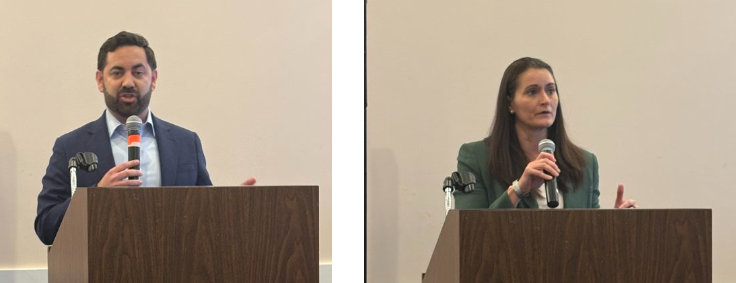
New City, NY – Republican Congressman Mike Lawler and Democratic challenger Cait Conley faced off Sunday morning, November 1, 2026, at the New City Jewish Center, just two days before voters decide who will represent New York’s 17th Congressional District.
The approximately 54-minute debate covered some of the most important issues facing Hudson Valley residents, including the cost of living, federal taxes, health insurance, immigration enforcement, national security, housing affordability, and the federal government’s growing debt.
The candidates also challenged each other’s political independence, ties to the Hudson Valley, and ability to deliver results in Washington.
The debate was part of the New City Jewish Center’s annual “Meet the Candidates” breakfast, which began at 9 a.m. following the return to Eastern Standard Time earlier that morning. Additional discussions featured candidates running for New York State Senate District 38, Assembly District 96, and Clarkstown Town Supervisor.
For Lawler and Conley, the debate was another opportunity to reach voters in one of the most closely watched congressional races in the country.
The 17th Congressional District includes all of Rockland and Putnam counties, along with portions of Westchester and Dutchess counties. The race could help determine which political party controls the U.S. House of Representatives after the November 3 election.
Lawler, who was first elected to Congress in 2022 and reelected in 2024, is seeking a third term. Conley, a West Point graduate and former Army officer with extensive military and national security experience, is seeking her first elected office.
Throughout the morning, Lawler emphasized his congressional voting record, federal funding, constituent assistance, and relationships with lawmakers from both parties.
Conley focused on rising household expenses, the Trump administration’s policies, the cost of health care, and what she described as a need for greater accountability in Washington.
Although the candidates agreed on certain issues, including the importance of national security and the need for housing and health care improvements, they differed sharply on how those goals should be accomplished.
Different Backgrounds, Different Arguments for Congress
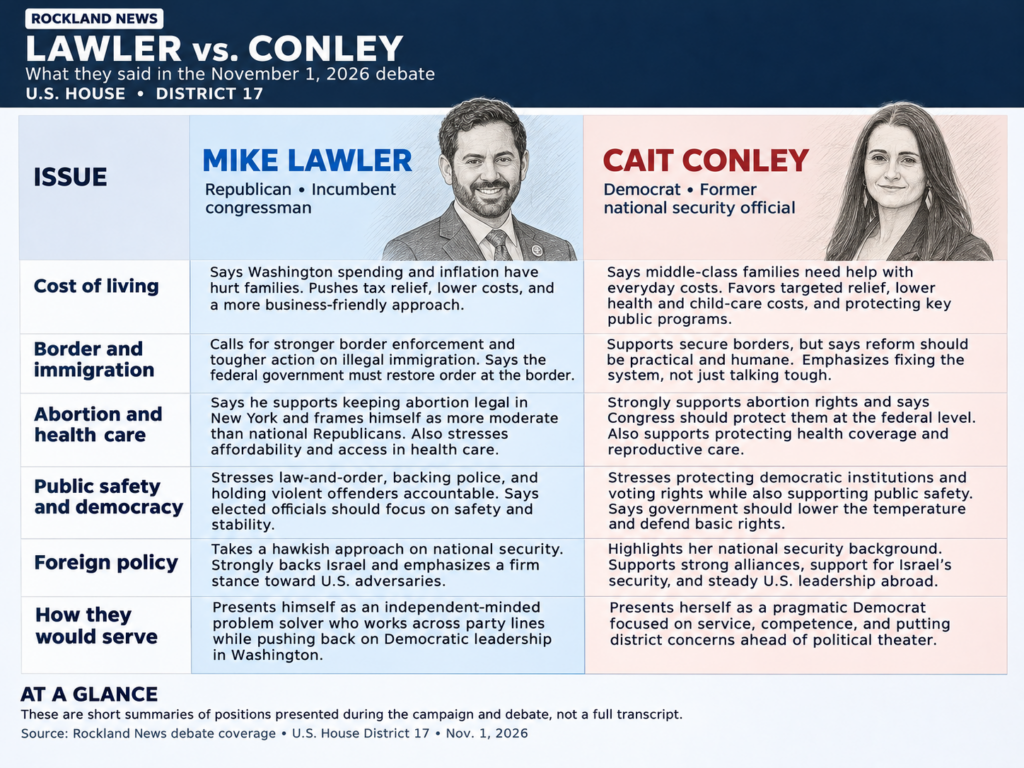
Conley opened by discussing her family’s long history in the Hudson Valley.
She described relatives who worked in the region’s brickyards and construction industry, along with her mother, who spent 48 years working for the United States Postal Service.
Conley said those family connections helped shape her commitment to public service.
Following the September 11, 2001 terrorist attacks, she attended the United States Military Academy at West Point and went on to serve approximately 16 years on active duty.
She said her military career included six overseas tours, service in Afghanistan, and assignments in special operations involving threats from international terrorist organizations.
Conley presented her military experience as preparation for serving in Congress, arguing that public officials should place the nation’s interests ahead of political parties or individual leaders.
She also criticized the current administration, arguing that federal policies have favored wealthy individuals and political interests while leaving working families struggling financially.
Lawler began by discussing his background as a lifelong Rockland County resident.
He emphasized that he owns a home, pays local taxes, and is raising his family in the congressional district.
Lawler said his office has handled more than 10,000 constituent cases and secured more than $140 million in federal benefits and community project funding for the district.
He also said he has participated in more than 2,000 in-person events and helped pass more than two dozen bills, including 17 that he said have been signed into law.
Those figures were presented by Lawler as evidence of his effectiveness in Congress.
He also discussed his role as chairman of the House Foreign Affairs Subcommittee on the Middle East and North Africa, where he has worked on legislation targeting Iranian oil transactions and international sanctions.
Lawler argued that his experience and established relationships in Congress allow him to obtain results for the district.
Debate Over President Trump and Political Independence
One of the first exchanges involved Conley’s criticism of Lawler’s voting relationship with President Donald Trump.
Conley said an outside organization had calculated that Lawler supported the president’s agenda on all of the votes included in its analysis.
She pointed specifically to Trump’s tariff policies and Lawler’s support for the major federal tax and spending legislation commonly called the One Big Beautiful Bill Act.
Conley argued that those decisions have increased expenses for Hudson Valley households and put health insurance coverage at risk.
She claimed tariffs have increased costs by approximately $4,200 per household, although that figure was not independently established during the debate.
Conley also criticized the health care changes in the federal legislation, arguing that they would cause many New Yorkers to lose coverage.
Lawler rejected the characterization that he votes with Trump 100 percent of the time.
He argued that the analysis cited by Conley covered only a selected group of votes rather than his entire congressional voting record.
Lawler listed several issues on which he said he had disagreed with Trump, including protections for Haitian immigrants, enhanced Affordable Care Act premium tax credits, Ukraine policy, labor rights, and federal tax deductions for state and local taxes.
He said disagreements between elected officials are necessary and that working with a president does not require agreeing with every policy.
Conley responded that Lawler’s disagreements had not always produced changes in federal policy.
She pointed to the expiration of enhanced health insurance subsidies and federal decisions affecting Haitian immigrants as examples.
Lawler countered that refusing to work with the administration would make it more difficult to accomplish anything for the district.
The exchange reflected a central disagreement in the campaign.
Lawler argued that his willingness to work with Trump and other political leaders allows him to influence legislation.
Conley argued that the congressman has supported major administration policies that she believes have harmed residents, regardless of disagreements he may have expressed on individual issues.
The debate did not include a complete examination of Lawler’s congressional voting history, and the competing claims about his overall voting record were not resolved.
National Security: Foreign Threats or Domestic Institutions?
The candidates were asked about the greatest threats facing the United States.
Lawler identified China, Russia, and Iran as major international concerns.
He described China as America’s leading geopolitical competitor and argued that the three countries have worked to undermine United States national security and economic interests.
Lawler criticized Conley for statements he attributed to her regarding Americans who voted for President Trump.
Conley disputed his characterization of her position and focused instead on what she described as threats to democratic institutions from the federal government’s exercise of power.
She expressed concern about the independence of government agencies, the integrity of elections, and actions she believes weaken public confidence in government.
Conley said protecting American democracy is a national security responsibility.
The candidates’ responses emphasized different types of threats rather than presenting a complete disagreement over national defense.
Lawler focused on foreign governments and international security challenges.
Conley focused on the protection of American institutions and limits on executive authority.
Conley also noted that she had supported targeted United States military strikes against Iranian nuclear facilities, demonstrating that her criticism of the administration does not extend to every national security decision it has made.
Questions About Conley’s Ties to the Hudson Valley
Another exchange focused on whether Conley had sufficient connections to the district she hopes to represent.
A question referenced her years serving in Washington and overseas, along with reports that Democratic political leaders had encouraged her to challenge Lawler.
Conley responded by emphasizing that her family had lived and worked in the Hudson Valley for four generations.
She said her decision to serve in the military required her to spend years away from home and argued that such service should not be viewed as evidence of a weak connection to the community.
Conley also criticized Lawler for previously considering a campaign for New York governor.
She suggested that his political ambitions raised questions about whether representing the district remained his primary priority.
Lawler strongly challenged Conley’s residency claims.
He argued that she had lived in Virginia, maintained property there, and had not established the same long-term residential and financial ties to the district that he has.
Lawler said his experience living in Rockland County gives him firsthand knowledge of local taxes, housing expenses, and community concerns.
Conley maintained that her family’s history and military service connect her to the district and prepare her to represent its residents.
The exchange became one of the more personal portions of the debate, with the candidates disagreeing over what qualifies someone to represent a community.
Immigration Enforcement and Cooperation With Local Police
Immigration produced another lengthy disagreement.
The candidates were asked what role local law enforcement should play in cooperating with Immigration and Customs Enforcement, commonly known as ICE, when dealing with individuals who have criminal backgrounds.
Conley described her experience as a military police officer and said she supports coordination between local, state, and federal law enforcement agencies.
She also said border security is an important part of national security.
Conley supported the removal of violent criminals, human traffickers, drug cartel members, and individuals connected to terrorist organizations.
However, she criticized immigration enforcement practices that she believes have placed people who do not pose public safety threats at risk.
She specifically discussed concerns among Rockland County’s Haitian community, including immigrants working in health care.
Conley said immigration officers should be subject to clear professional standards, including wearing identification, using body cameras, and following rules comparable to those governing local police departments.
She also stated directly that she does not support sanctuary policies, while calling for reform of the immigration system and stronger oversight of federal enforcement practices.
Lawler argued that restrictions on cooperation between local police and federal immigration authorities have weakened public safety.
He criticized policies in New York that he said prevent local authorities from fully assisting federal immigration enforcement.
Lawler cited violent incidents involving individuals he identified as being in the country unlawfully, including deaths he connected to weaknesses in immigration policy.
He also presented figures concerning federal immigration detainer requests and individuals with criminal convictions who, according to his statements, had been released from custody.
Those figures and the circumstances surrounding the incidents were not independently established during the debate.
Lawler argued that local authorities should be able to cooperate fully with federal agencies when people in custody are wanted for immigration enforcement.
He also disputed Conley’s opposition to sanctuary policies, claiming that her broader political positions were inconsistent with that statement.
The candidates shared support for removing dangerous offenders and securing the border.
Their disagreement concerned how immigration laws should be enforced, the limits of federal authority, and whether existing state restrictions on cooperation with ICE protect or endanger the public.
National Debt and Federal Spending
The growing federal debt became another major topic.
Lawler said both political parties share responsibility for the country’s financial problems.
He argued that Washington cannot continue increasing federal spending without addressing the long-term consequences.
Lawler supported a combination of economic growth, additional government revenue, and spending reductions.
He said every federal department should be examined for possible savings, including the Department of Defense.
Lawler specifically opposed a proposed $1.5 trillion defense spending level, calling it financially unsustainable.
He also said Social Security and Medicare must be protected by addressing their long-term funding challenges.
One proposal he discussed would direct federal revenue from new offshore oil leases into Social Security’s trust fund.
Lawler argued that protecting these programs requires bipartisan cooperation rather than legislation developed by only one party.
Conley challenged Lawler’s position by criticizing his vote for the 2025 federal tax and spending law.
She argued that the legislation added substantially to the national debt while reducing resources for health care and other public services.
Conley also expressed concern about reductions affecting the Cybersecurity and Infrastructure Security Agency, where she previously worked.
She described that agency’s responsibilities for protecting critical infrastructure from cyberattacks and physical threats.
Conley argued that federal spending decisions should place greater emphasis on public safety, national security, and services used by ordinary Americans.
Both candidates acknowledged the seriousness of the debt.
Lawler emphasized spending reductions and economic growth as necessary steps.
Conley questioned whether recent tax and spending decisions were consistent with responsible budgeting.
State and Local Tax Deductions Become a Major Dispute
One of the most detailed exchanges concerned the federal deduction for state and local taxes, commonly known as SALT.
The issue is particularly important in the Hudson Valley because many homeowners pay substantial property and state income taxes.
Before 2018, eligible taxpayers generally could deduct the full amount of their state and local taxes if they itemized deductions on their federal returns.
The 2017 federal tax law introduced a $10,000 limit.
Under the 2025 federal tax legislation, that limit increased to $40,000 for many eligible taxpayers, with income-based restrictions. The higher limit is scheduled to return to $10,000 in 2030.
Lawler defended the legislation, saying the higher deduction provided important relief to middle-class residents.
He argued that the law also preserved other federal tax benefits that otherwise would have expired, including lower income tax rates and changes to the standard deduction and child tax credit.
According to Lawler, allowing all of those provisions to expire would have increased taxes for many Hudson Valley households.
Conley offered a different interpretation.
She argued that the original $10,000 SALT limit had been scheduled to expire after 2025 and that Congress could have allowed the deduction to return to its earlier structure.
Instead, she said, the new legislation made the limit permanent while providing only a temporary increase.
She criticized the arrangement because the deduction is scheduled to fall back to $10,000 in 2030.
Lawler responded that considering the SALT provision alone ignored the other tax changes that would have expired.
He also argued that removing the limit entirely would provide particularly large benefits to higher-income taxpayers.
The disagreement involved two different questions: whether the temporary increase helps taxpayers now, and whether Congress should have restored an unlimited deduction instead.
For residents, the actual benefit depends on household income, filing status, itemized deductions, and future changes to federal tax law.
Health Care Costs and Medicaid Take Center Stage
Health care became one of the longest and most detailed portions of the debate.
Both candidates described the current health care system as expensive and in need of reform.
They also agreed that private health insurance should remain available and rejected a complete government-run single-payer system.
Their differences centered on Medicaid policy, federal spending, and the appropriate role of government in regulating insurance companies.
Lawler defended changes to Medicaid included in the 2025 tax and spending legislation.
He said the changes were intended to strengthen eligibility verification and require certain adults receiving benefits to participate in work, education, or community service.
Lawler argued that government assistance should remain available to those who qualify while encouraging able-bodied adults without dependent children to participate in the workforce.
He also criticized the growth of insurance company profits and the consolidation of health insurers with medical providers.
Lawler said the country needs more competition among insurers and supported arrangements that allow small businesses to combine their purchasing power to obtain employee health insurance.
Conley argued that the federal legislation would reduce health insurance coverage and worsen financial pressures on families.
She described residents who struggle to pay for prescriptions, medical care, groceries, and utility bills.
Conley also criticized provisions affecting Planned Parenthood and federal support for health services.
She said Congress should address insurance company practices that raise costs or limit access to treatment.
Conley supported allowing small businesses to pool resources when purchasing insurance, an area of agreement with Lawler.
She also called for action against pharmaceutical industry practices that delay lower-cost competing medicines from reaching the market.
Independent federal estimates provide context for the disagreement over Medicaid.
The Congressional Budget Office has projected that the Medicaid provisions of the 2025 law will reduce federal spending and increase the number of uninsured Americans. One CBO estimate projected approximately 7.5 million additional uninsured people by 2034 from those provisions.
That projection does not settle every argument the candidates made about the law, but it confirms that the coverage consequences extend beyond changes to administrative procedures.
The candidates also differed over how to improve hospital funding.
Lawler cited additional federal support for community health centers, a $50 billion rural health program, and efforts to obtain federal reimbursements and other funding for New York hospitals.
He specifically discussed Westchester Medical Center and potential benefits for Good Samaritan Hospital in Rockland County.
Some of the funding figures he mentioned involved programs already established, while others concerned ongoing proposals or efforts to obtain additional payments.
Conley argued that the broader health care policies supported by Lawler were placing financial pressure on hospitals and patients, despite individual funding initiatives.
Neither candidate presented a complete estimate of how much their proposed reforms would lower the average Rockland resident’s health insurance premium.
Housing Affordability and New Proposals for Homebuyers
When the candidates were asked which issues deserved more attention, Conley selected housing affordability.
She said rising home prices and mortgage costs are making it increasingly difficult for working families to remain in the communities where they grew up.
Conley linked part of the problem to tariffs on imported building materials, arguing that the added costs make new home construction and repairs more expensive.
She also expressed concern about interest rates and the financial pressures facing borrowers.
Conley then presented a proposal she called the American Public Service Home Loan Program.
The idea would extend certain home financing benefits similar to those available through veterans’ mortgage programs to people who complete at least 10 years of qualifying public service.
Eligible workers could include police officers, firefighters, nurses, teachers, and others working in public service.
Conley said the program would use federal loan guarantees to help eligible buyers obtain mortgages with competitive interest rates, without down payments or private mortgage insurance.
She argued that people who spend their careers serving a community should have a better opportunity to purchase homes there.
Lawler responded by discussing his work on federal housing legislation.
He said the country needs millions of additional housing units and that increasing construction is essential to lowering prices.
Lawler pointed to legislation intended to reduce regulations, improve financing opportunities, and expand the supply of homes.
He also discussed increasing the federal capital gains exclusion for homeowners selling their primary residences.
Under current federal tax rules, eligible homeowners may exclude a portion of the profit from selling their primary residence. Lawler argued that increasing those limits could make it easier for older homeowners to sell larger houses and move into smaller homes or retirement communities.
He said that would make more existing homes available to younger families.
Lawler questioned whether Conley’s proposed mortgage guarantee program would be practical for banks and lenders.
Conley, meanwhile, argued that increasing the housing supply alone would not solve the problem for families who still cannot afford mortgages.
The two approaches addressed different parts of the housing market.
Lawler emphasized expanding the number of available homes and reducing barriers to development.
Conley emphasized helping eligible buyers afford homes through financing assistance, along with lowering construction costs.
Neither candidate provided a complete cost estimate for the housing proposals during the debate.
Israel, Antisemitism and Foreign Policy
Israel and the security of Jewish communities were also important subjects throughout the discussion.
Lawler emphasized his work on the House Foreign Affairs Committee and his support for the United States-Israel relationship.
He discussed legislation intended to restrict financial transactions involving Iran, which he described as a major source of support for terrorist organizations.
Lawler also criticized certain Democratic lawmakers over their positions on Israel and questioned Conley’s political associations with officials whose policies he opposes.
Conley strongly rejected suggestions that she does not support Israel.
She said her national security career included operations involving terrorist organizations that threaten the United States and its allies.
Conley supported continued American cooperation with Israel and described the security relationship as important to United States national interests.
In her closing remarks, she addressed the Jewish community directly.
Conley said that, as a member of the LGBTQ community who served in the military during the period when the “Don’t Ask, Don’t Tell” policy restricted openly gay military service, she remembered the support Jewish organizations and community members provided in the fight for equal rights.
She said that experience was part of her commitment to opposing antisemitism and supporting the safety of Jewish Americans.
Conley also stated that she supports Israel’s right to exist as a Jewish and democratic state.
At the same time, she said supporting Israel does not mean agreeing with every decision made by its government.
She argued that American officials should be willing to criticize any administration, including Israel’s, when they believe its actions are wrong.
The candidates therefore expressed support for Israel’s security and the American-Israeli relationship, while differing over political alliances, criticism of government policies, and how they believe those commitments should be demonstrated.
Can Either Candidate Work Across Party Lines?
The final question asked how the candidates would appeal to independent voters and members of the opposing political party.
Conley said many of the district’s problems should not be treated as partisan issues.
She identified housing affordability, job training, economic opportunity, and stronger educational pathways as areas where Democrats and Republicans should cooperate.
She specifically mentioned Rockland Community College, BOCES programs, and vocational training as examples of institutions and programs that can help residents prepare for better-paying jobs.
Conley also pointed to her proposed public service home loan program, saying it was similar to legislation previously introduced by Republicans.
She described her military experience as evidence that people with different political beliefs can work together toward common goals.
Conley said she had spoken with Republican and independent voters who were willing to consider supporting her because of her military service and concerns about the direction of the country.
Lawler responded that bipartisanship should be measured by legislative accomplishments rather than campaign promises.
He highlighted his membership in the bipartisan Problem Solvers Caucus and his working relationship with Democratic Congressman Josh Gottheimer of New Jersey.
Lawler said many bills he supported had received substantial backing from members of both parties.
He also cited endorsements from Democratic elected officials, including Congressman Jared Golden of Maine, as evidence of his ability to build relationships beyond the Republican Party.
Lawler maintained that meaningful compromise requires elected officials to work with people whose political views they do not share.
The candidates agreed that cooperation between political parties is necessary.
Lawler emphasized his record of working with Democrats already serving in government.
Conley emphasized her military background and said she would bring a less partisan approach to addressing the district’s problems.
Closing Statements: Experience Versus Change
Lawler concluded by thanking the New City Jewish Center, Conley, and the audience for participating.
He acknowledged that the campaign had been difficult and described the race as one of national importance.
Lawler estimated that more than $60 million had been spent in connection with the election, arguing that the district’s importance had drawn national political attention.
He said voters did not need to agree with every position he takes to support his reelection.
Lawler returned to his record of constituent assistance, federal funding, and bipartisan legislative work as reasons voters should give him another term.
Conley used her closing statement to emphasize her military service, her commitment to national security, and her belief that Washington needs different leadership.
She again discussed the importance of Israel’s security, the protection of civil rights, and the responsibilities of public officials to serve all Americans.
Conley said the country faces serious challenges that require government to put public needs ahead of personal or political interests.
She described her decision to run for Congress as an extension of her military commitment to the United States.
Two Competing Visions for the 17th Congressional District
The November 1 debate presented voters with a detailed comparison of two candidates who have different professional backgrounds and different ideas about the role of Congress.
Lawler offered his congressional experience as the strongest argument for reelection.
He emphasized his work securing federal resources, helping constituents, building bipartisan relationships, and supporting legislation intended to lower taxes and expand economic opportunity.
Conley argued that the district needs new representation willing to challenge the administration on affordability, health care, immigration enforcement, and government accountability.
She emphasized her experience in the military and national security, along with proposals intended to assist working families and people seeking homeownership.
The candidates identified several common concerns.
Both said housing is too expensive, health insurance needs reform, national security is important, and government must address its financial challenges.
Both opposed replacing all private health insurance with a single government-run system.
Both supported cooperation between law enforcement agencies to address serious criminal threats.
Both also expressed support for Israel’s security and the importance of working across political party lines.
Their disagreements involved how to address those issues, which federal policies should continue, and whether the current administration’s decisions have helped or harmed residents.
The debate also included significant personal criticism, particularly concerning Conley’s residency history, Lawler’s relationship with President Trump, and each candidate’s political judgment.
Several financial and statistical claims were disputed or were presented without enough supporting information during the event to independently determine their accuracy.
Those claims are separate from the candidates’ stated policy positions, which voters can compare directly.
With Election Day approaching, the choice facing residents of the 17th Congressional District centers on whether to continue with Lawler’s established record in Congress or elect Conley to pursue a different approach.
Voters will decide that question Tuesday, November 3, 2026.
Rockland News Debate Coverage
Rockland News recorded the November 1 debate between Mike Lawler and Cait Conley at the New City Jewish Center.
The recording provides residents with an opportunity to hear the candidates’ responses directly, including their exchanges over taxation, health care, immigration, housing, and national security.
Rockland News will also provide separate coverage of the other candidate discussions held during the “Meet the Candidates” breakfast.
For additional election coverage and future debate recordings, visit RocklandNews.com.