





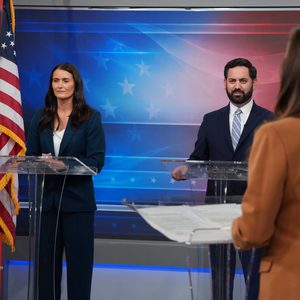
Republican Rep. Mike Lawler and Democratic challenger Cait Conley outlined different approaches to Rockland County’s issues of housing, energy, immigration and health care during their debate Monday at the News 12 studio in Long Island, September 28, 2026.
Both challenged the other’s honesty, political independence and ability to represent the Hudson Valley.
Moderated by Tara Rosenblum, the debate focused on viewer questions about New York’s 17th Congressional District, which includes Rockland County, NY. Some questions produced clear policy differences. Others led to personal criticism or ended without a direct answer.
Lawler pointed out his legislative record since 2023, emphasizing his work with Democrats and questioned Conley’s employment in the technology industry. Conley repeatedly attempted to link Lawler to President Donald Trump, arguing that his votes had increased household costs and weakened health care coverage.
Although both accused the other of lying, not every disagreement established a contradiction. Several involved different interpretations of legislation, disputed claims or questions that remained unanswered.
Money, Energy and Housing
The opening discussion focused on money. Asked for three specific steps to lower costs, Lawler cited tax relief, housing legislation and increased energy production. He highlighted the increase in the state and local tax deduction cap from $10,000 to $40,000, along with housing proposals intended to encourage construction and improve access to financing.
Lawler also described the Republican tax changes as providing “no tax on Social Security.” That description needs qualification. The law created an additional deduction for eligible seniors, but Social Security benefits can still be taxable depending on income. It did not eliminate taxes on benefits for everyone.
Conley focused on housing supply and assistance for buyers. She proposed a home loan program modeled on veterans’ benefits for teachers, nurses, law enforcement officers and first responders who complete 10 years of service. She also argued that Trump’s tariffs had made construction materials more expensive.
Neither gave a clear timetable for when families would see the requested savings.
On electricity costs, Lawler blamed state policies for limiting energy supply. He supported faster permitting, natural gas extraction and rebuilding and reopening Indian Point, along with renewable energy development.
Rosenblum questioned whether reopening Indian Point was realistic, given its ongoing decommissioning and opposition from state and local officials. Lawler pointed to Michigan’s effort to restart the Palisades nuclear plant, but did not explain how he would overcome the obstacles facing Indian Point.
Conley called for tying utility profits to performance, preventing certain corporate expenses from being passed to customers and restoring incentives for renewable energy. She also criticized Lawler’s previous work as a utility lobbyist.
Lawler said Conley had offered no plan to increase electricity supply. Conley disputed that statement, citing her support for solar and wind incentives. Both favored additional energy production, but differed over how to achieve it.
Tariffs and College Costs
A prolonged discussion about tariffs – a national issue that has polarized many on both sides of the aisle – ended with no clear resolution or winner.
Lawler defended tariffs as tools for negotiating better trade terms with Europe and China. Asked whether Trump had made any mistakes in his tariff policy, he did not identify a decision he would change.
Conley said tariffs should be used as a “scalpel” to support specific American industries. She criticized the administration’s broader approach, arguing that it had raised household costs. Asked which tariffs she would keep or eliminate, she did not identify specific products or countries.
The candidates agreed more closely on college affordability. Lawler cited legislation introduced with Democratic Rep. Jared Moskowitz to cap student loan interest rates at 2%.
Conley also supported a cap, without naming a rate. Both backed vocational education, apprenticeships and other paths to employment that do not require a four-year degree.
Taxes and Health Care
On Social Security, Lawler called for a bipartisan working group and new revenue sources. He also argued that Social Security could not legally be changed through the budget reconciliation process used to pass the Republican tax-and-spending law.
Conley proposed applying payroll taxes to earnings above $400,000. She said the Republican law had shortened Social Security’s solvency by six months, a claim that prompted Lawler to accuse her of lying.
Neither clearly chose between the two legislative approaches presented in the viewer’s question.
The exchange mixed two separate issues: changing Social Security benefits and changing the tax revenue supporting them. The Social Security trustees’ 2026 summary states that the One Big Beautiful Bill Act reduced projected revenue from taxes on benefits. That confirms a financing effect, but does not, by itself, establish Conley’s specific six-month figure.
A question about mental health became a longer argument over Medicaid.
Lawler cited legislation to improve mental health access for caregivers and called for lower treatment costs. In defending the Republican tax-and-spending law, he said its eligibility checks and work requirements protected coverage for eligible recipients. He also argued that Medicaid spending would continue to grow.
Conley said his stated support for health care access conflicted with his vote for the law, which she said cut Medicaid and caused people to lose insurance.
Lawler also rejected Conley’s repeated statement that he had voted with Trump “100 percent of the time,” pointing to his bipartisan work and disagreements with the administration. Conley continued to use that figure, but the debate did not establish which votes or time period it covered.
Immigration and Security
Immigration produced both clear differences and areas of agreement.
The parents of Sheridan Gorman asked whether the candidates supported New York’s law limiting certain forms of cooperation with federal immigration authorities. They also asked whether Congress should override those restrictions.
Lawler opposed the law and supported federal action against sanctuary policies. He said Conley supported the state law and opposed an override, although she had not stated either position in her answer.
Conley emphasized border security and enforcement against violent criminals. She criticized immigration operations targeting people she described as peaceful members of their communities. She did not directly answer the questions about the state law or a federal override.
On broader immigration reform, Lawler supported legal status for qualifying longtime undocumented residents through the Dignity Act. Conley supported a pathway to citizenship for longtime residents who had not committed crimes.
Both favored body cameras, identification and restrictions on masks for immigration agents. Both also condemned the Minneapolis killings discussed during the debate.
A question about Flock cameras brought concerns about both public safety and privacy.
Conley called for federal privacy protections but devoted much of her answer to social media and Congress’s failure to regulate technology.
Lawler defended license-plate readers as useful crime-solving tools while expressing concern about AI combining surveillance information. Neither described specific rules for how long information should be kept, who should receive it or when police should need a warrant.
Lawler said he had opposed the president’s position on Haitian Temporary Protected Status and worked on individual cases. Conley argued that his relationship with Trump had not delivered enough protection. Their disagreement centered on whether his efforts had been effective.
Military and International Aid
On Israel, Conley supported continued American assistance and applying the Leahy laws, which govern military aid. She said she would have opposed the aid-cutting amendment Rosenblum described.
Lawler also supported continued assistance, arguing that it served American security interests. He said Israel could decide when it no longer needed that support. Both candidates rejected describing Israel’s actions in Gaza as genocide.
Conley supported recognizing a Palestinian state, with conditions excluding Hamas from its governing structure. Lawler also made recognition conditional on removing Hamas from power.
Conley opposed further Israeli settlement expansion in the West Bank. Lawler defended Israel’s authority to maintain settlements in areas he described as under its control, without directly stating whether he supported further expansion.
Socialism and Nuclear Weapons
The discussion became more confrontational over Zohran Mamdani. Conley condemned antisemitism and said she disagreed with members of the Democratic Socialists of America. Lawler repeatedly pressed her to denounce Mamdani by name, but she did not make the specific denunciation he requested.
On Iran, Conley said the country should not obtain a nuclear weapon, but criticized the administration’s military approach as lacking clear objectives and an exit strategy. She accused Lawler of supporting the war without enough oversight.
Lawler also opposed Iran obtaining a nuclear weapon. He stressed preventing that outcome and confronting support for terrorism.
Abortion
The candidates differed on reproductive rights.
Conley supported putting the protections of Roe v. Wade into federal law and restoring funding and access she said Republican policies had restricted.
Lawler said he opposed a federal abortion ban and restrictions on mifepristone. He also supported legislation and tax assistance to improve access to IVF.
AI and Data Centers
Artificial intelligence led to some of the debate’s most personal accusations.
Conley called for federal regulation and criticized Lawler’s support for a proposal limiting states’ ability to regulate AI.
Lawler said he disagreed with Trump’s resistance to slowing AI development and cited legislation addressing dangerous AI systems and testing requirements. He then accused Conley of receiving substantial pay for a “no-show job” connected to AI companies and questioned her ties to the district. Those allegations were not established as fact during the debate.
In the exchange that followed, Conley discussed her military service and overseas assignments, saying they explained her time away from the Hudson Valley. She also criticized Lawler for staying home after September 11.
Lawler said he was questioning her private-sector employment after government service, not her military record. Conley’s response did not explain the job duties he had challenged.
The argument then turned to Rockland County data centers.
Conley said five had been built on Lawler’s watch, with three more on the way, and called for a moratorium. Lawler said the existing facilities predated his service in Congress and supported the financial industry.
Conley then pointed to three facilities she said were being built during his time in office. That response addressed current construction but did not resolve the disagreement over when the five existing facilities were built.
Rosenblum asked Conley to explain how her support for a moratorium fit with an earlier statement supporting data centers that benefit communities. Conley returned to criticizing Lawler without explaining what would qualify as a community benefit or when a moratorium should end.
Asked about a proposed expansion in Orangetown, Lawler supported local zoning authority and said he backed moratoriums adopted by Orangetown and East Fishkill.
Conley argued that his position conflicted with his vote to limit state AI regulation. Lawler responded that the proposal did not concern local zoning.
The exchange involved separate questions about regulating technology and deciding where facilities may be built. The proposed ten-year restriction on state AI regulation was also removed from the reconciliation legislation by a 99–1 Senate vote. Supporting an earlier version of a bill and describing what became law are different matters.
Closing Statements
During shorter exchanges, Conley and Lawler both supported banning congressional trading in individual stocks and eliminating congestion pricing. Conley said legal cannabis was helping New York, while Lawler said it was hurting.
Conley did not give a clear final yes-or-no answer in the supplied transcript to a question about venue decisions involving performer Macklemore. Lawler supported the decisions described by the moderator.
Conley closed by promising to address corruption, establish term limits and lower household costs. Lawler emphasized constituent services, his legislative record and his willingness to disagree with the president.
Advertisements