





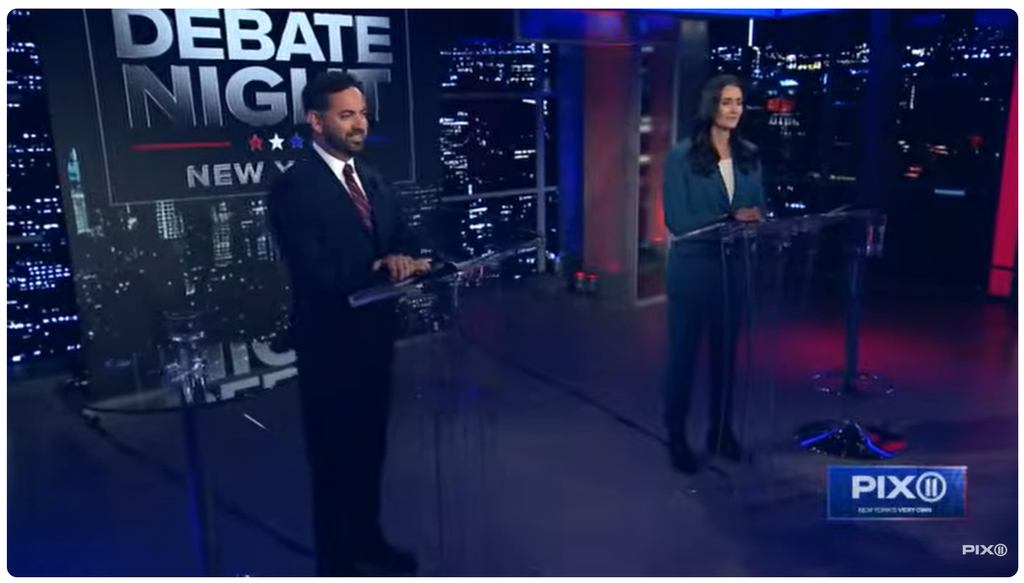
The candidates for New York’s 17th Congressional District challenged each other’s records and independence while offering competing approaches to housing, artificial intelligence and public safety.
Republican Rep. Mike Lawler and Democratic challenger Cait Conley traded sharp accusations during their second debate in the race for New York’s 17th Congressional District, presenting voters with different explanations for rising costs and different approaches to immigration enforcement, energy development and American military involvement overseas.
The PIX11 debate, moderated by Dan Mannarino, also revealed agreement on several subjects. Both candidates supported continued military assistance to Israel, endorsed body cameras and identifiable uniforms for immigration agents, and called for preparing workers for changes brought by artificial intelligence.
Their disagreements often centered on how those goals should be achieved — and whether either candidate could be trusted to act independently of political allies and financial supporters.
Lawler emphasized his congressional record, bipartisan relationships and constituent services. Conley emphasized her military and national security experience while arguing that Lawler’s support for President Donald Trump’s agenda had harmed Hudson Valley families.
The district includes all of Rockland and Putnam counties and portions of Westchester and Dutchess counties. Its voters will choose their representative in the November 3 election.
Throughout the debate, Mannarino pressed the candidates to return to specific questions when their answers shifted toward attacks. Those follow-ups exposed distinctions between their stated priorities, their proposed solutions and the details they left unresolved.
Watch the full debate on PIX 11’s YouTube channel.
Artificial Intelligence Opens an Immediate Confrontation
The opening policy discussion concerned whether Congress should impose mandatory safety rules or freeze development of the most powerful artificial intelligence systems.
Conley called for federal regulations and safeguards, describing AI as a national security and public safety concern. She cited her work at the Cybersecurity and Infrastructure Security Agency as relevant experience and accused Congress of failing to confront the industry’s risks.
She also criticized Lawler’s support for a version of federal legislation that, she said, would have prevented states from regulating AI for 10 years.
Lawler responded by attacking Conley’s private-sector work, alleging that her financial relationships compromised her independence on the issue. Conley rejected that characterization, describing her work as a continuation of her national security service, including work for a company providing drone detection systems to protect American soldiers.
On policy, Lawler cited legislation developed with Democratic Rep. Josh Gottheimer of New Jersey. He said their proposals would establish federal standards for dangerous AI systems, require testing of advanced models and address automated systems capable of hacking computer networks.
Neither candidate explicitly endorsed a blanket freeze on development of the most powerful AI systems. Both instead described forms of regulation, although their exchange quickly became a dispute over whose professional and political relationships deserved greater scrutiny.
The discussion was more specific when it turned to employment.
Conley proposed investing in trade schools, BOCES programs, community colleges and apprenticeships. She highlighted training for electrical work and solar-related occupations and called for protections against mass firings.
Lawler proposed tax credits to help small businesses train employees to use AI. He also supported changes in elementary, secondary and higher education, along with greater access to vocational programs.
Their shared objective was to help workers adapt. Conley placed greater emphasis on workforce development and employee protections; Lawler emphasized helping businesses incorporate AI without replacing their employees.
Data Centers: Local Approval, Different Views on a Moratorium
Data center development brought the discussion directly into Rockland County.
Lawler distinguished existing financial-services data centers from large facilities supporting AI. He said local governments should control zoning decisions and that companies developing major AI facilities should pay for the power generation they require.
Asked whether he would support additional facilities if local communities approved them, Lawler answered yes.
He supported local moratoriums in Orangetown and East Fishkill while criticizing Gov. Kathy Hochul’s statewide approach. He also connected data center growth to his broader energy agenda: reopening Indian Point, expanding natural gas production and building pipelines.
Conley supported a moratorium, arguing that development should be evaluated for its effects on utility bills, the environment and surrounding communities.
When Mannarino asked whether she would support additional data centers after the moratorium ended, she gave a conditional answer.
“It depends on the conditions,” Conley said. Facilities would need community approval and would have to be a net positive for the community, she added.
That exchange established an important distinction: Conley did not propose a permanent prohibition, and Lawler did not endorse development without local approval. They differed over whether a broader pause was necessary and how to manage the industry’s costs.
They also disputed Lawler’s responsibility for existing facilities and the effects of federal tax provisions. Conley characterized the provisions as a benefit to data center developers. Lawler said the business-expensing provision she criticized applied broadly to American businesses.
Those competing descriptions remained unresolved during the debate.
Immigration: Agreement on Equipment, Conflict Over Enforcement
The immigration discussion began with a question about how to ensure that Immigration and Customs Enforcement agents follow required training and what discipline they should face when they do not.
Conley said immigration enforcement should target violent criminals, drug cartels, human traffickers and terrorist organizations. Drawing on her experience as a military police officer, she argued that federal agents should meet basic public safety standards.
She supported body cameras, visible identification and uniforms, and opposed agents wearing masks.
Lawler endorsed those same reforms but directed much of his response toward restrictions on cooperation between local police and federal immigration authorities. He argued that such restrictions prevent the removal of people who commit crimes.
Mannarino followed up with both candidates on the original question about discipline. Neither identified a specific penalty or detailed disciplinary process for agents who violate training requirements. Conley returned to congressional oversight and operating standards; Lawler returned to immigration enforcement and public safety.
A subsequent question produced a more direct point of agreement. Asked whether local police should be allowed to notify ICE when they arrest someone who is in the country illegally, both answered yes.
Their explanations differed.
Conley supported coordination among local, state and federal agencies to remove violent criminals while arguing that local police should not take over the federal government’s civil immigration responsibilities.
Lawler advocated broader cooperation and said people who enter the country illegally and commit crimes should not receive protection from removal.
The exchange became particularly heated over the killing of Sheridan Gorman. Lawler invoked her death as an example of the consequences he attributed to sanctuary policies and accused Conley of supporting policies that allowed her accused killer to remain in the country.
Conley rejected that characterization. She called the killing an atrocious crime and said the man should have been deported.
As Lawler continued questioning her, Mannarino intervened: “There’s not a cross-examination round here.”
Independence From Trump and the Democratic Left
Both candidates faced questions about whether their claims of political independence matched their positions.
Asked where he disagreed with Trump, Lawler cited the state and local tax deduction, protections for Haitians with Temporary Protected Status, enhanced Affordable Care Act premium tax credits, collective bargaining rights and support for Ukraine.
He also pointed to endorsements from Democrats as evidence that his work crossed party lines.
Conley argued that Lawler’s disagreements with Trump did not outweigh his support for policies involving tariffs, Iran and health care that she said harmed the district.
The candidates disputed how often Lawler voted with Trump. Conley cited a voting tracker to support her claim of complete alignment. Lawler argued that the tracker covered only a portion of congressional votes and did not represent his full record.
The debate did not resolve that methodological disagreement. Their percentages should therefore be understood as competing descriptions of his record, rather than interchangeable measurements.
Conley, meanwhile, was asked where she differed from New York City Mayor Zohran Mamdani and the Democratic Socialists of America.
She said she was not a DSA member and emphasized support for law enforcement and border security. She argued that the Democratic Party’s future could be represented by candidates with backgrounds like hers in the Hudson Valley.
When Lawler challenged her to condemn Mamdani’s October 7 statement, she did so directly.
“Yes, I do denounce Mamdani’s statement on October seventh,” Conley said, adding that she condemned antisemitism regardless of its political source.
Tariffs and the Cost of Everyday Life
Affordability was a recurring theme, but the candidates identified different causes and remedies.
Conley argued that Trump’s tariffs increased the cost of groceries, household products and construction materials. She called for repealing them and repeatedly linked Lawler’s congressional votes to the financial pressures facing district residents.
Lawler defended tariffs as a potentially useful short-term negotiating tool against unfair trade practices. He argued that barriers imposed by other countries had contributed to the loss of American manufacturing jobs.
He also criticized Trump’s implementation, saying repeated changes in tariff rates created volatility.
Pressed to say whether the tariffs were helping or hurting families, Lawler described their effects as mixed.
A question about household grocery spending brought the discussion to personal experience.
Lawler said his household, which includes his wife, children and in-laws, spends about $500 per week on groceries. He did not specify how much that figure had increased over the previous year.
Conley said her weekly grocery bill was approximately $300, an increase of about $75 over the year.
Their proposals for reducing broader costs reflected their different priorities.
Lawler emphasized increasing domestic energy production, simplifying permitting and expanding housing supply. He argued that energy prices affect transportation, manufacturing and food costs throughout the economy.
Conley emphasized reversing tariffs and ending the broader war in Iran, arguing that both trade policy and higher fuel costs were increasing the price of everyday goods.
Both supplied numerical claims about economic conditions and policy effects. Those figures were presented as part of their arguments and were not independently established during the debate.
Housing: More Construction and Help for Buyers
Both candidates said housing supply needed to increase, but they emphasized different tools.
Lawler highlighted a bipartisan housing package he said he helped advance. He described measures intended to reduce regulatory barriers, expand manufactured housing and improve access to financing for builders and buyers.
He also pointed to an expansion of the low-income housing tax credit and criticized New York’s taxes, business regulations and requirements for electric systems in new construction.
Conley divided the problem into two parts: increasing the supply of housing and helping people afford to buy it.
She argued that tariffs were making construction more expensive and proposed a public-service home loan program modeled on benefits available to veterans.
Under her proposal, people who had worked for 10 years as teachers, nurses, first responders or law enforcement officers could qualify for similar home-financing benefits.
The debate did not establish the program’s cost, funding source or full eligibility rules. It nevertheless provided a specific example of how Conley would approach homeownership for workers serving local communities.
Sexual Assault Questions Become a Personal Dispute
A question about sexual assault allegations at Cornell University and whether there should be a federal definition of consent led to one of the debate’s most confrontational exchanges.
Conley called for changes in how campus sexual violence is investigated but said she was unsure whether the necessary reforms belonged at the federal or state level.
She then criticized Lawler’s response to domestic abuse allegations involving Rep. Max Miller. Lawler denied her accusation that he had blamed Miller’s former wife and countered by criticizing Conley’s acceptance of support from former Gov. Eliot Spitzer.
The exchange shifted away from the original policy question as each candidate challenged the other’s judgment concerning political associates.
Conley accused Lawler of “mansplaining” and rejected his characterization of how she should respond to abuse allegations.
When Mannarino returned to the question about consent, Lawler said he was open to considering an appropriate federal definition. He placed greater emphasis on changing New York law and requiring reports to law enforcement.
Neither candidate presented a developed federal consent proposal.
On a related question, however, their responses were direct: both opposed the Title IX changes as described by the moderator. Lawler also emphasized protecting students against antisemitism and other civil rights violations.
Iran: Agreement on Preventing Nuclear Weapons, Division Over the War
Both candidates said Iran should not obtain a nuclear weapon. Their disagreement concerned the scope and strategy of American military action.
Conley supported targeted strikes against nuclear-related facilities, including strikes she said she had backed the previous year. She opposed the broader war, arguing that the administration lacked clear objectives and an exit strategy.
She also criticized Congress for failing to exercise sufficient oversight.
Lawler defended his votes against efforts to end the military operation, arguing that Iran’s nuclear ambitions, missile capabilities and support for armed groups presented threats that required action.
He blamed earlier American policy toward Iran, including what he described as inadequate sanctions enforcement, for strengthening the Iranian government and its partners.
Asked how the war should end, Conley called for working with allies to apply economic pressure and secure negotiations, including reopening the Strait of Hormuz while preventing Iran from acquiring a nuclear weapon.
Lawler said economic pressure was already being applied and argued that it needed to continue.
Neither supplied a detailed timetable for ending the conflict or a complete set of conditions for withdrawing American forces.
Both Support Continued Military Aid to Israel
Asked whether the United States should continue funding both offensive and defensive weapons for Israel, both candidates answered yes.
Lawler described Israel as a central American ally and emphasized intelligence cooperation, regional security and the protection of Americans living or serving in the region.
Conley also described Israel as a strategic partner and supported its right to exist and defend its population. She distinguished that support from approval of every decision by Prime Minister Benjamin Netanyahu’s government.
She said she would criticize Israeli leadership when she believed its actions harmed Israeli or American interests.
Both also condemned antisemitism.
Where the Candidates Stand
This table summarizes positions expressed during the debate. Claims about legislative accomplishments and opponents’ records reflect the candidates’ statements.
| Issue | Mike Lawler | Cait Conley |
|---|---|---|
| AI safety | Supports federal standards, testing of advanced systems and legislation addressing dangerous automated agents. | Supports federal safeguards and oversight; criticized efforts to restrict state regulation. |
| AI and employment | Proposes small-business tax credits for employee training, education changes and vocational access. | Supports BOCES, community colleges, apprenticeships and protections against mass firings. |
| Data centers | Supports local zoning authority and local moratoriums; opposes the governor’s broader approach. Says developers should pay for needed power generation. | Supports a moratorium; would consider later projects with community approval and demonstrated community benefits. |
| ICE operating standards | Supports body cameras, identifiable uniforms and no masks. Did not specify disciplinary penalties. | Supports body cameras, identification and no masks. Did not specify disciplinary penalties. |
| Local police and ICE | Supports broader cooperation and opposes sanctuary restrictions. | Supports coordination to remove violent criminals while keeping local police focused on local responsibilities. |
| Tariffs | Supports their limited use as negotiating tools; criticizes fluctuating rates and acknowledges mixed effects. | Calls for repealing the tariffs, arguing they raise household and business costs. |
| Energy and affordability | Supports more domestic oil and gas production, pipelines, nuclear power and permitting reform. | Emphasized ending the broader Iran war and reversing tariffs to reduce costs; did not present a comprehensive energy plan during the debate. |
| Housing | Emphasizes construction, fewer regulatory barriers, manufactured housing and access to financing. | Supports increasing supply, reducing tariff-related construction costs and creating public-service home loans. |
| Federal consent standard | Open to considering one; emphasizes state-law changes and mandatory reporting to law enforcement. | Calls for reform but did not commit to whether it should be federal or state-based. |
| Title IX | Opposes the changes described by the moderator. | Opposes the changes described by the moderator. |
| Iran | Supports continuing the operation and opposes efforts to require its termination. | Opposes the broader war but supports targeted action to prevent an Iranian nuclear weapon. |
| Military assistance to Israel | Supports offensive and defensive assistance and strongly defends the strategic partnership. | Supports both forms of assistance while reserving criticism of Netanyahu’s government. |
| House leadership | Supports Mike Johnson for speaker. | Supports Hakeem Jeffries for speaker. |
“Best Lines of the Night”: The Sharpest Retorts
The debate’s most pointed lines often served a larger campaign argument. The following exchanges are notable for what they conveyed, rather than as a ranking of who won the encounter.
Conley on Lawler’s criticism of her defense-related work:
“Whose whole combat experience starts and ends on Twitter.”
The remark contrasted Conley’s military background with Lawler’s political career. It came as she defended work involving systems intended to protect soldiers.
Lawler’s immediate response:
“I’m glad you delivered your pre written line by your consultants.”
Lawler challenged the authenticity of Conley’s attack before returning to his allegations about her industry relationships.
Lawler on Conley’s local ties:
“I know you just moved here from Virginia, so it’s hard for you to understand the local communities.”
The line reflected his repeated effort to question her familiarity with the district. Conley, in contrast, emphasized being born and raised in the Hudson Valley before her military service.
Conley during the data center tax dispute:
“Mike, if only you understood it a bit more, maybe you wouldn’t be doing so much harm.”
The retort followed Lawler’s argument that she misunderstood the business-expensing provision she was criticizing. It captured their opposing descriptions of the same tax policy.
Conley during the affordability discussion:
“Man, the struggle for him to answer a question is real tonight.”
Conley used the line to portray Lawler as evasive. The exchange followed questions that prompted him to discuss energy production and broader economic policy.
Conley during the argument over sexual violence:
“I do not need you to mansplain to me, Mike.”
The remark came during a heated exchange over allegations involving political figures and how the candidates had responded to them. It also marked a moment when the discussion moved substantially away from the moderator’s question about consent law.
Lawler in his closing statement:
“Most members of Congress can’t even point to one. Ask AOC how many she’s passed.”
The jab at Rep. Alexandria Ocasio-Cortez accompanied Lawler’s claim that his legislative record demonstrated effectiveness. It was directed at another member of Congress rather than Conley.
Conley in her closing statement:
“You deserve a patriot, not a puppet.”
The line condensed her central argument that Lawler was too closely aligned with Trump. Lawler’s closing statement offered the opposite characterization: an incumbent willing to agree or disagree with the president according to the district’s interests.
What the Answers Established — and Left Open
The debate gave voters several clear choices.
On tariffs, Conley called for repeal while Lawler defended limited use. On Iran, Conley opposed the broader war while Lawler defended continuing the operation. On data centers, both supported community approval but differed over a broader moratorium. On housing, Lawler emphasized supply and regulatory changes, while Conley added a proposed benefit for public-service workers.
Other answers were less complete.
Neither candidate specified discipline for ICE agents who disregard training. Neither presented a finished federal consent proposal or a detailed timetable for ending the Iran conflict. Conley outlined a public-service mortgage concept without explaining its financing, while Lawler cited housing measures without establishing when local buyers would see lower prices.
The candidates also demonstrated that agreement on a general principle does not necessarily mean agreement on implementation. Both supported immigration enforcement, worker preparation for AI and military assistance to Israel, but placed different conditions and priorities around those commitments.
Lawler asked voters to judge his congressional accomplishments, accessibility and bipartisan work. Conley asked them to judge the consequences of his votes and the alternative offered by her military and national security experience.
Advertisements