





New president outlines plans to strengthen the college’s finances, expand career opportunities and improve student success.
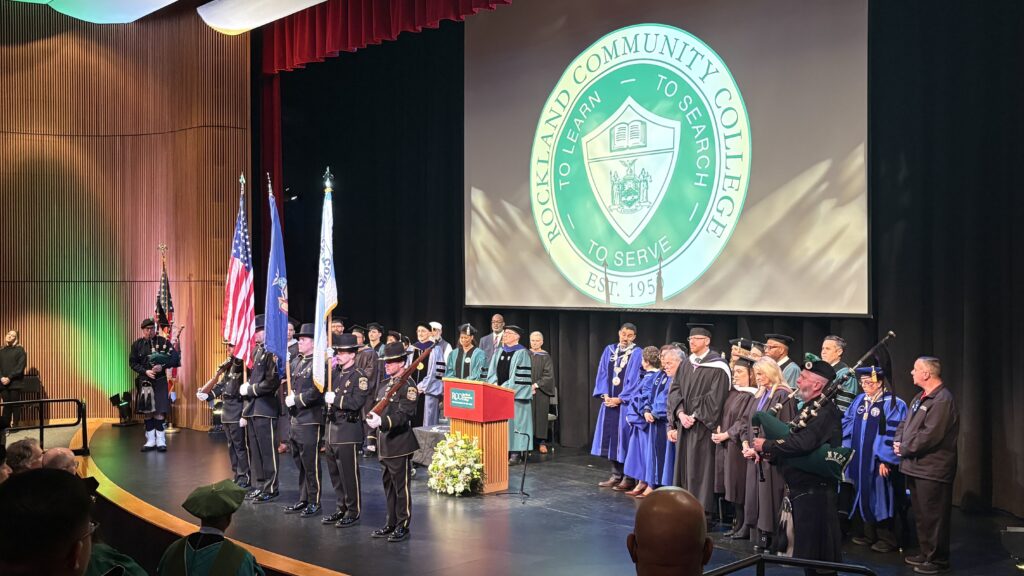
Suffern, NY – Dr. William P. Mullaney was formally inaugurated as the ninth president of Rockland Community College (RCC) on Monday, November 9, 2026, during a ceremony at the college’s Cultural Arts Center in Suffern.
The ceremony brought together students, faculty, administrators, elected officials, community leaders and representatives of the State University of New York (SUNY) to recognize Mullaney’s leadership and hear his vision for the institution’s future.
SUNY Chancellor Dr. John B. King Jr. conducted the formal investiture, officially recognizing Mullaney’s authority and responsibilities as president. Although the inauguration took place Monday, Mullaney has served as RCC’s president since June 2025, following his appointment in December 2024.
A Focus on Stability and Student Success
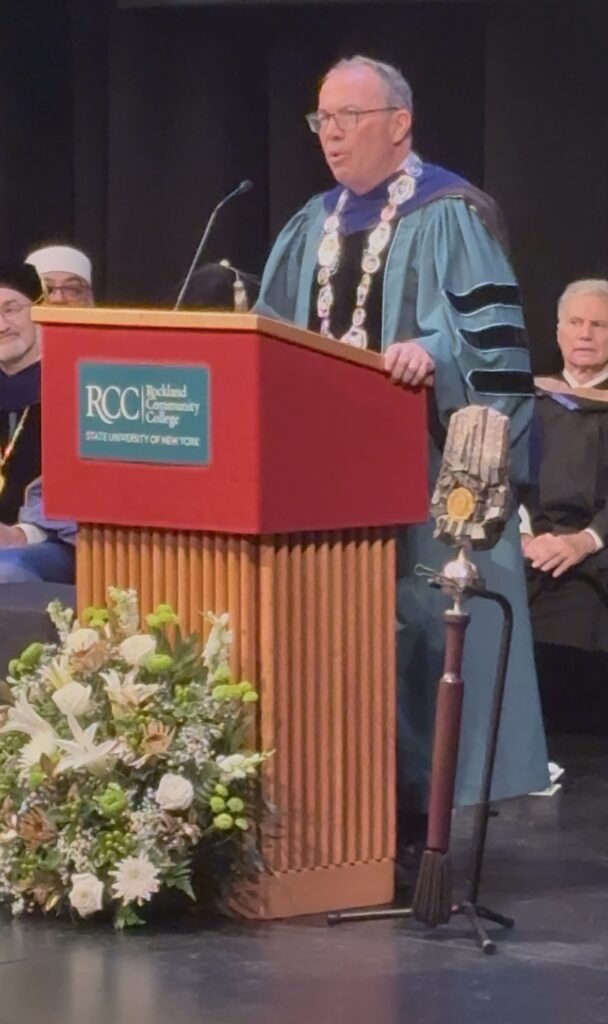
During his inaugural address, Mullaney discussed the challenges facing higher education and outlined his priorities for Rockland Community College.
He emphasized three areas of institutional development: financial stability, workforce support and rebuilding relationships between the college and the surrounding community.
Mullaney said the college has made progress strengthening its financial position, creating greater workforce stability and restoring confidence in its future.
He also acknowledged that the institution has experienced difficult periods in recent years, while expressing confidence in the resilience of its employees and students.
“We’ve begun rebuilding our relationships by connecting RCC with the broader community because the college’s future and the county’s future are inseparable,” Mullaney said.
Looking ahead, Mullaney identified increasing student enrollment, improving retention rates and helping more students graduate as central goals of his administration.
However, he emphasized that graduation itself should not be the college’s only measure of success.
“Our end goal for our students cannot just be to hand them an RCC diploma or certificate,” Mullaney said. “We need to provide them with the tools to earn a family sustaining wage down the road.”
To accomplish this, he described plans to strengthen educational programs that prepare students for careers in healthcare, nursing, technology, advanced manufacturing and emerging industries.
Other priorities include expanding internship opportunities, developing stronger relationships with employers and encouraging adults to return to college to pursue new skills or career opportunities.
Mullaney also emphasized the importance of helping students transfer successfully to four-year colleges and universities.
A Personal Journey into Higher Education
Mullaney devoted a significant portion of his address to the people and experiences that shaped his career.
A first-generation college student raised on Long Island, he recalled growing up in a family where higher education was strongly encouraged despite financial limitations.
His maternal grandparents came from Albania, while his paternal grandparents came from Ireland. Neither of his parents had the financial opportunity to attend college, but both encouraged their children to pursue higher education.
Mullaney also shared a childhood experience involving a speech impediment and a teacher who helped him develop his speaking abilities.
He credited educators and mentors throughout his life with helping him develop the confidence and skills necessary to become a college professor and eventually an administrator.
His career began in the classroom as an English professor, where he developed an appreciation for the challenges faced by community college students.
He recalled reading student essays describing financial struggles, homelessness, incarceration and other personal difficulties. Those experiences helped shape his commitment to educational accessibility and student support.
Mullaney also recognized the influence of women throughout his professional career, including former supervisors, faculty colleagues and mentors who encouraged him to pursue leadership positions.
SUNY and County Leaders Recognize Mullaney
Chancellor King highlighted Mullaney’s previous six-year tenure as president of SUNY Corning Community College.
During that period, Mullaney helped introduce academic programs in mechatronics, automotive technology, battery technology and digital design.
King also recognized his work expanding educational access, including programs serving incarcerated individuals and students facing financial barriers.
The chancellor noted that Mullaney’s original inauguration at Corning was canceled because of the COVID-19 pandemic, making Monday’s ceremony his first formal presidential inauguration despite his previous experience.
SUNY Board of Trustees Chair Dr. Merryl H. Tisch also participated in the ceremony.
Rockland County Executive Ed Day praised Mullaney’s emphasis on fiscal responsibility, student achievement and strengthening RCC’s role in the local economy.
Day acknowledged that the college had experienced serious challenges and credited Mullaney with demonstrating leadership during difficult circumstances.
Rockland County Legislator Jesse Malowitz, an RCC graduate, discussed the college’s influence on his own educational and professional development.
Malowitz described RCC as an important pathway for residents seeking career training, professional advancement or opportunities to continue their education at four-year institutions.
Students and Faculty Emphasize Collaboration
Student Government Association President Shayla Watson spoke about Mullaney’s willingness to engage directly with students.
Watson described meetings in which the president listened to student concerns, discussed potential solutions and encouraged continued communication.
Representatives of RCC’s Faculty Senate and Assembly of Staff and Administrators also recognized his commitment to shared governance, collaboration and institutional transparency.
The ceremony opened with reflections and prayers representing Christian, Jewish and Muslim traditions, emphasizing the college’s connection to Rockland County’s diverse communities.
Two longtime professional colleagues, Dr. Randall VanWagener, president of Mohawk Valley Community College, and Dr. Maria Harper-Marinick, former chancellor of the Maricopa Community Colleges, offered personal reflections on Mullaney’s leadership and career.
Both emphasized his commitment to students, his willingness to listen and his collaborative leadership approach.
Honoring RCC’s Past While Planning Its Future
Near the conclusion of the ceremony, Mullaney received a three-dimensional model of historic Brucker Hall, the building where RCC’s first students attended classes in 1959.
The presentation connected the college’s early history with its current leadership transition.
Established in 1959, Rockland Community College has served generations of students pursuing associate degrees, professional training and pathways to further education.
The inauguration also marked the beginning of a week of college activities, including the RCC Foundation’s Champions of Change Celebration on November 12 and a veterans luncheon on November 13.
In closing, Mullaney expressed gratitude to his family, teachers, colleagues, students and the Rockland County community.
He described his approach to the presidency as one that recognizes the college’s history while concentrating on its future.
Mullaney said he was looking in two directions: “backward with gratitude and forward with hope.”
His message throughout the ceremony centered on a common theme: that RCC’s long-term success will depend on collaboration, sound financial management and preparing students for opportunities beyond the classroom.
Advertisements