

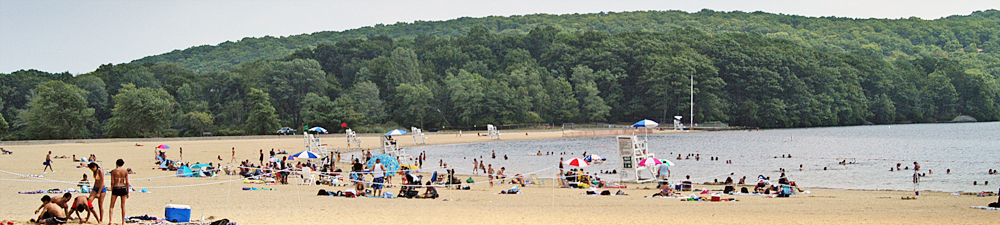
Lake Welch Beach, Picnic Grounds and Public Boat Launch have closed until further notice due to a Harmful Algal Bloom (HAB) that has affected all of Lake Welch. The closures are necessary to protect public health and safety. Visitors should seek alternate locations for swimming and picnicking.
A harmful algal bloom (HAB) (or excessive algae growth) is an algal bloom that causes negative impacts to other organisms via production of natural algae-produced toxins, mechanical damage to other organisms, or by other means. HABs are sometimes defined as only those algal blooms that produce toxins, and sometimes as any algal bloom that can result in severely lower oxygen levels in natural waters, killing organisms in marine or fresh waters. Blooms can last from a few days to many months. After the bloom dies, the microbes that decompose the dead algae use up more of the oxygen, generating a “dead zone” which can cause fish die-offs. When these zones cover a large area for an extended period of time, neither fish nor plants are able to survive. Harmful algal blooms in marine environments are often called “red tides”.
It is sometimes unclear what causes HABs; their occurrence in some locations appears to be entirely natural,[4] while in others they appear to be a result of human activities. In certain locations there are links to particular drivers like nutrients, but HABs have also been occurring since before humans started to affect the environment. HABs are induced by eutrophication, which is an overabundance of nutrients in the water. The two most common nutrients are fixed nitrogen (nitrates, ammonia, and urea) and phosphate.The excess nutrients are emitted by agriculture, industrial pollution, excessive fertilizer use in urban/suburban areas, and associated urban runoff. Higher water temperature and low circulation also contribute.
HABs can cause significant harm to animals, the environment and economies. They have been increasing in size and frequency worldwide, a fact that many experts attribute to global climate change. The U.S. National Oceanic and Atmospheric Administration (NOAA) predicts more harmful blooms in the Pacific Ocean. Potential remedies include chemical treatment, additional reservoirs, sensors and monitoring devices, reducing nutrient runoff, research and management as well as monitoring and reporting.