


By Thomas Brady, with assistance of Rockland News Staff
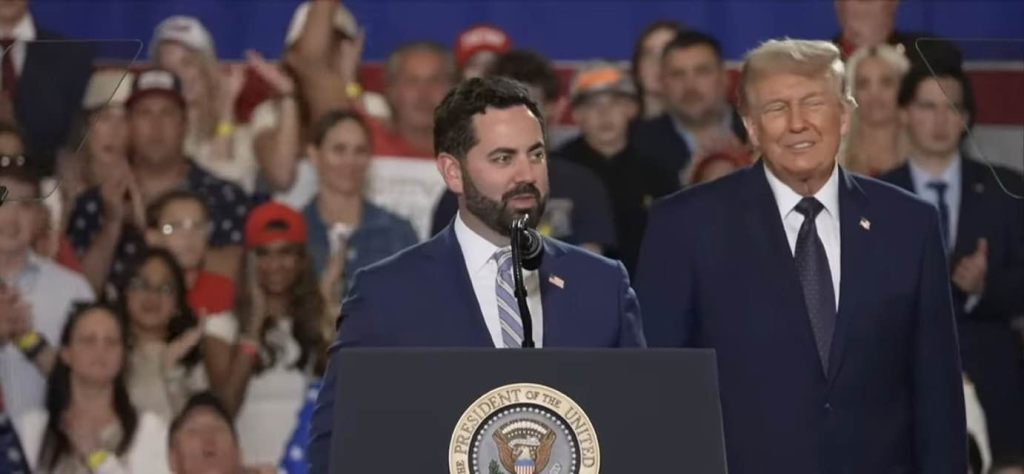
SUFFERN, N.Y. — President Donald J. Trump’s visit to Rockland Community College on Friday placed Rockland County at the center of a national political and economic debate, as the president appeared alongside Congressman Mike Lawler to promote tax relief, praise local supporters and highlight several Hudson Valley residents whose stories were used to frame the administration’s message on affordability, public safety and immigration.
The event, held at the Eugene Levy Fieldhouse on the RCC campus in Suffern, drew heavy security, traffic restrictions and significant local attention. Monsey Scoop reported that doors were expected to open at 11 a.m. for the 3 p.m. remarks, with law enforcement preparing for congestion and road closures around the county. News 12 reported that Trump spoke before thousands at the Fieldhouse and described the visit as the first by a sitting president to Rockland County since President Gerald Ford in 1976.
Trump’s appearance was built largely around Lawler and the federal state and local tax deduction, known as SALT, a major issue in Rockland and other high-tax suburban communities. Reuters reported that Trump used the appearance to support Lawler in one of the nation’s most competitive House districts, while centering some of his remarks on the SALT deduction and calling Lawler “Mr. Salt.” Mid-Hudson News reported that the legislative deal raised the SALT cap from $10,000 to $40,000.
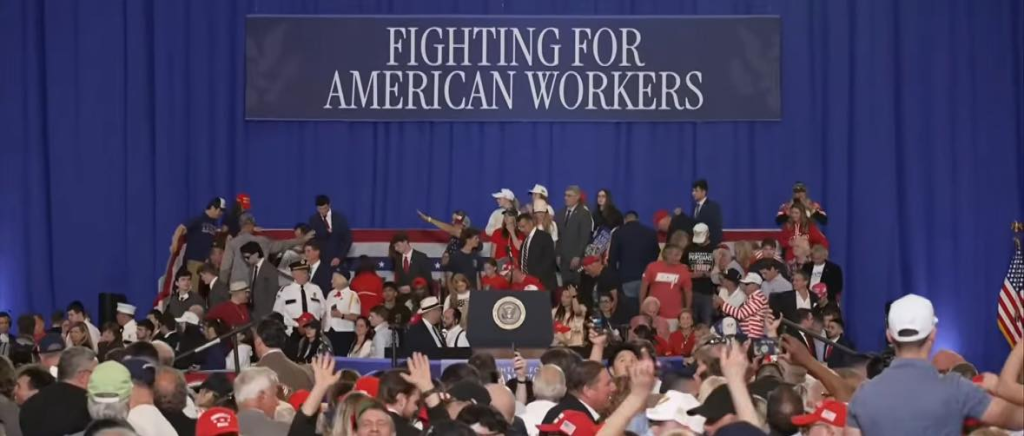
On stage, Trump repeatedly credited Lawler with pressing the issue in Washington. “He didn’t stop,” Trump said of Lawler, according to the event transcript. Lawler later thanked Trump for working with him to raise the cap and said more than 90 percent of his constituents were able to fully deduct their state and local taxes.
Local Residents Speak on Stage
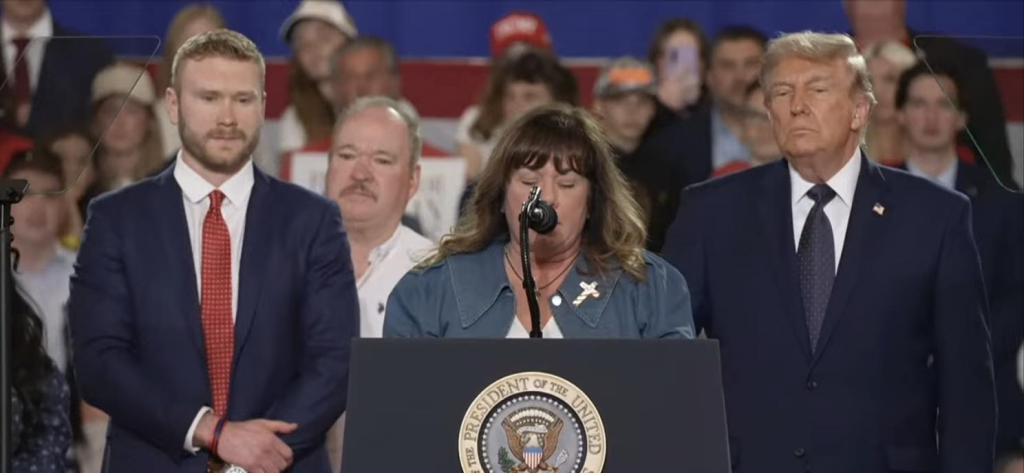
The most local portions of the program came when Trump invited residents and regional families to speak.
One of them was Kathy Kennedy, identified from the stage as a retired special education teacher from Orangetown. Trump said Kennedy had saved almost $3,000 because of the SALT deduction. Kennedy then told the crowd she was grateful for “tax rebates” and for work by local lawmakers that she said made Rockland “stronger, safer, and more affordable for families.” She said such efforts help children remain in the county, build futures and invest in the community.
Another local family, described on stage as small business owners involved in home inspection, real estate and land investment, said the tax changes had allowed them to put money back into their businesses and their children’s future. The family said the savings gave them more room to invest locally rather than “simply getting by.”
The program also included a Rockland-specific tribute to Welles Remy Crowther, the Upper Nyack native remembered as the “Man in the Red Bandana” for helping people escape the World Trade Center on Sept. 11, 2001. Trump announced that Crowther would be posthumously awarded the Presidential Medal of Freedom. Crowther’s mother, Alison Crowther, thanked Trump, Lawler and others involved, saying her son’s example of courage and humanity continues to inspire children and audiences across the country.
Trump then brought forward the family of Sheridan Grace Gorman, an 18-year-old Loyola University Chicago student from Yorktown Heights who was shot and killed in Chicago on March 19 while walking with friends near the university. WABC reported that Gorman was a Loyola student from Westchester County and was killed near the campus area.
Her mother, Jessica Gorman, and father, Thomas Gorman, spoke at length. Jessica Gorman described the pain of losing her daughter and thanked people from New York, Chicago, Rockland County and Westchester County who had reached out to the family. Thomas Gorman said the family supports legal immigration but believes stronger enforcement is needed when public safety is at stake. “Protecting our people is not politics,” he said. “It is the first responsibility of government.”
Trump used the Gorman family’s appearance to return to one of the central themes of his speech: opposition to sanctuary policies and support for stricter immigration enforcement. Those remarks, like much of the event, were sharply political and included criticism of Democratic leaders in New York and nationally. The Associated Press reported that the speech was presented as an economic event but moved across a wide range of subjects, including voter identification, crime, transgender athletes and attacks on Democrats.
Protestors At the Four Corners Rally Today
As President Trump prepared to speak at Rockland Community College on Friday, May 22, 2026, protesters gathered at the Four Corners — the intersection of Route 59 and Middletown Road in Nanuet — a longtime Rockland protest site that has also hosted weekly anti-Trump rallies and two No Kings Day demonstrations. Rockland News has reached out several times to the office of Assemblyman Patrick J. Carroll, who represents New York’s 96th Assembly District, to ask whether he has pursued New York State DOT safety measures, including guard rails or other roadside protections, along Route 59 for demonstrators at the intersection.
Carroll has been openly critical of Clarkstown’s concerns involving residents protesting at the Four Corners; however, as of publication, Rockland News had not received information from his office identifying follow-up action with DOT on potential measures to better protect the protesters whose right to demonstrate he has defended. Carroll’s Assembly district is officially listed by the New York State Assembly as District 96.
Other News from Today’s Event
The president was introduced by New York Giants quarterback Jaxson Dart, who led the crowd in “Go Big Blue” chants before introducing Trump. The transcript shows the event had the atmosphere of a large political rally, with patriotic music, crowd chants and repeated applause lines.
While the White House and Republican supporters framed the visit as a message about taxes and affordability, its political significance was clear. AP reported that Lawler is running in one of the most closely watched House races in the country and that the event was officially classified as a White House event rather than a campaign appearance. Reuters similarly described Lawler’s district as a competitive lower Hudson Valley seat that could help determine control of Congress.
For Rockland County, the day was both a political event and a local moment. Trump used the RCC stage to promote national policies, but the program repeatedly returned to people and places familiar to the county: NY District 17, Orangetown taxpayers, Rockland small business owners, Upper Nyack’s Welles Crowther, and the broader Hudson Valley families whose stories were placed before a national audience.
Advertisements