



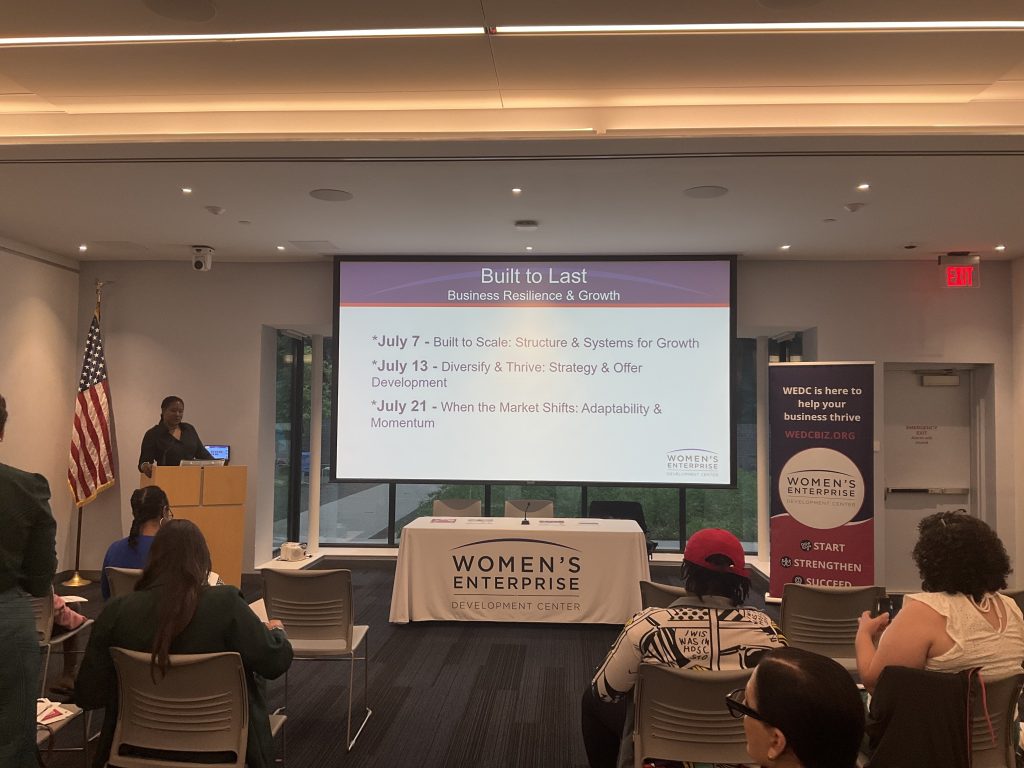
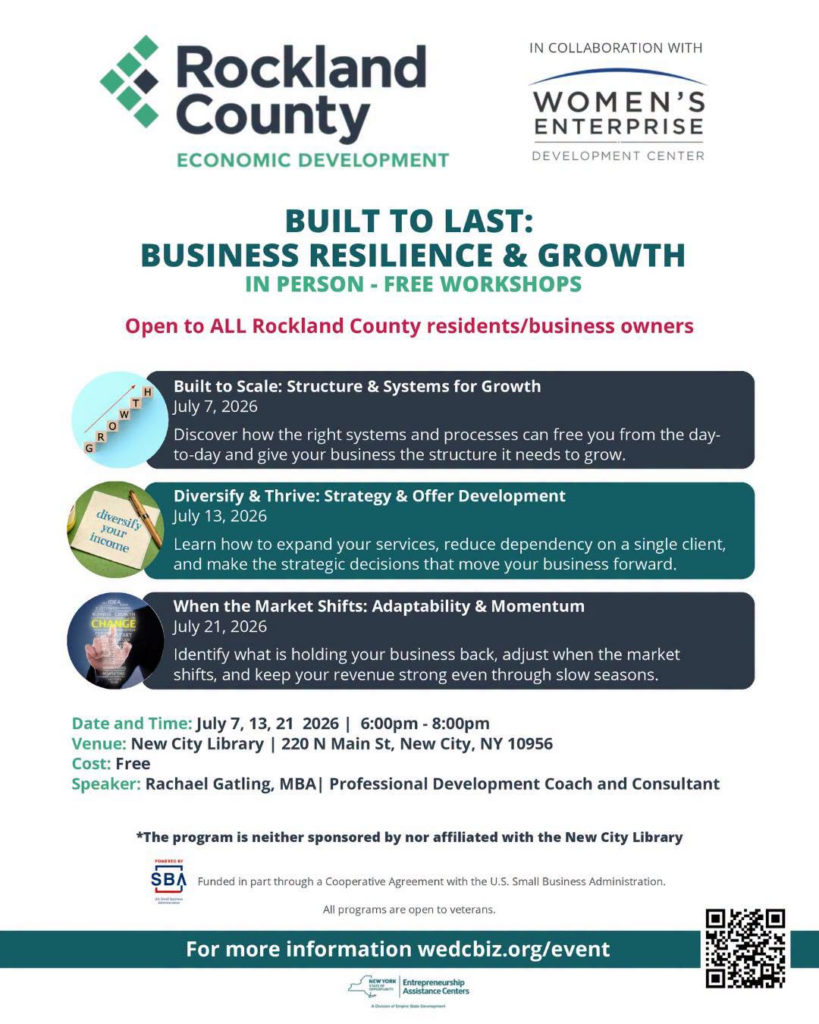
NEW CITY, NY — Rockland County entrepreneurs gathered Tuesday evening at New City Library for “Built to Scale: Structure & Systems for Growth,” a free two-hour workshop designed to help small business owners move beyond day-to-day demands and build more sustainable operations.
The session was part of the “Built to Last: Business Resilience & Growth” workshop series, sponsored by the County of Rockland’s Economic Development and Tourism Department and the Women’s Enterprise Development Center. The program was open to all Rockland County residents and business owners.
Facilitated by Rachael Gatling, MBA, a professional development coach and consultant, the workshop focused on a challenge familiar to many small business owners: how to grow without becoming trapped inside every task, every client request and every operational detail.
Approximately one dozen attended, seeking advice on how to structure their businesses – some startups, some established, some not-for-profit focused. Participants represented a wide range of industries and interests, including landscaping, graphic design, video production, notary services, financial services, consulting, food-related ventures and other small business fields.
While the audience included many women entrepreneurs, the session’s guidance applied broadly to any business owner seeking structure, focus and a clearer path to growth. Several men were in attendance, along with a young lady that – although likely in attendance alongside her Mom, was very keen to take notes.
Automate, Delegate, Document – How to Free Up Time
Gatling opened the evening by encouraging participants to identify and rely on their strengths. She framed the workshop around the idea that entrepreneurs do not need to change who they are to become more successful, but they may need to change the stories, habits and systems that are holding them back.
A central theme of the evening was the shift from being a “solopreneur” who handles everything personally to becoming a business owner with defined processes. Gatling asked participants to think about what they should stop doing, what they should start doing and what already works well enough to expand.
The discussion moved quickly from motivation to practical business structure. Participants were encouraged to examine whether repeated tasks could be documented, delegated, automated or handled through software. Gatling also urged business owners to protect the work that truly requires their expertise — what one attendee described as the business owner’s “secret sauce” — while finding ways to move other tasks off their own plates.
For many in the room, the conversation touched on real-life pressure points: giving away too much time in introductory calls, struggling to set prices, responding to clients without clear boundaries, balancing multiple ventures, and trying to make space for strategic planning while also managing daily responsibilities.
Gatling emphasized that growth requires clarity. Businesses, she said, need clear customer inquiry and response systems, client onboarding processes, meeting structures, payment terms, pricing and quoting practices, and marketing routines. She also encouraged participants to develop a “bench team” of professional supports, including banking, accounting, insurance and legal resources.
Everyone Has a Superpower
The session was interactive throughout. Attendees introduced their businesses, described the stages they were in, and identified what Gatling called their “superpower” — the individual strength or skill they bring to their work. The exercise helped create a collaborative tone in the room, with participants offering ideas, encouragement and observations to one another.
The workshop also addressed the emotional side of entrepreneurship. Several participants spoke about the difficulty of saying no, especially when starting out or when trying to help clients who may not fit the business’s ideal service model. Gatling encouraged intentional decision-making, reminding the group that boundaries, pricing and scheduling are not signs of inflexibility; they are signs that a business is being treated like a business.
Another recurring topic was time. Gatling encouraged business owners to schedule time for their own business development as seriously as they would schedule a client meeting. Blocking the calendar, documenting one process at a time and committing to small weekly actions were presented as manageable ways to move from overwhelm to progress.
The event’s practical focus reflected the larger goal of the series: helping Rockland entrepreneurs build resilience by creating businesses that can operate more efficiently, serve customers more consistently and adapt as conditions change.
Next Session: Monday July 13th
The next two sessions in the three-part series are scheduled for July 13 and July 21 at New City Library. Upcoming topics include strategy, offer development, adaptability and maintaining momentum when market conditions shift.
Registration for the series includes all three sessions. More information is available through the Rockland Economic Development Calendar, as well as the Women’s Enterprise Development Center’s events calendar.