

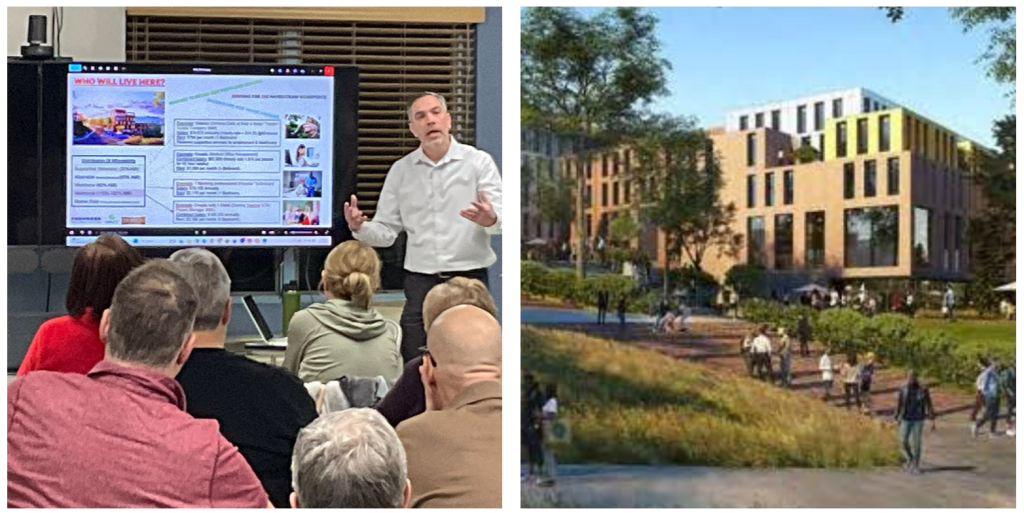
Haverstraw, NY – Residents filled a recent public meeting about the proposed redevelopment of the former Chair Factory site on Haverstraw’s Hudson River waterfront this evening, as the lead developer for the project addressed a variety of questions about parking, traffic, school impacts – and what results the project will create for downtown Haverstraw.
The session was moderated by Ryan Porter, managing partner of MPact Collective, one of the lead development groups working with Pennrose to move the project through local and state approvals. Plans call for roughly 450 rental apartments, public waterfront open space, a parking garage, and ground-floor retail in a long-vacant industrial area at the bottom of Main Street. Village and state materials describe the effort as a major waterfront redevelopment intended to bring new housing and economic activity to the village.
Porter told residents the team hopes to break ground this summer, with demolition expected to begin in the coming months. He said full build-out would take about 3.5 years and acknowledged that the process will be disruptive—bringing trucks, noise and construction traffic. “I’m not going to sugarcoat that,” he said, while advocating for the end result – a new riverfront neighborhood that could help boost Main Street.
A major theme was resilience and the potential for flooding. One resident noted the site is surrounded by water, and asked what happens during major storms. Porter said the buildings have been designed to sit above the “500-year flood” elevation, a requirement tied both to environmental rules and the reality of getting property insurance today. He also emphasized expensive shoreline work to take place during construction, including stabilizing the river’s edge and improving roads that are currently closer to dirt roads than modern infrastructure.
Housing Aimed for Workforce, Middle Income, Veterans
Porter also outlined how the apartments would be priced and who they are meant to serve. He described a mix of market-rate and income-restricted units—some set aside for veterans and some aimed at “essential workers” and other middle-income households. The goal, he said, is to keep rent around 30% of a household’s gross income, so residents can afford other basics like health care, child costs and education. He added that units would be mixed together within buildings—rather than separated by “good” and “bad” finishes—so residents across income levels live in the same quality apartments.
The recipients of the housing would be based on lottery, and is statewide – as per requirements for NY State-funded projects.
The tensest moment of the night centered on parking. One resident repeatedly argued that 450 apartments and about 570 parking spaces would not be enough, pushing for a two-spaces-per-unit standard and warning that nearby streets are already narrow. Porter pushed back, saying the team conducted parking utilization studies at 12 comparable properties—plus reviewed local examples—and concluded their ratio is sufficient, especially in a walkable downtown. He said the project is meant to encourage people to drive less and walk more, and he pointed to changing work habits like remote work. As the exchange grew a tad sharper, Porter tried to keep the meeting moving so others could ask questions, offered to send the parking study, and said he would check with his partners about details like assigned parking—while also arguing that unassigned garage parking is common in modern large developments.
One attendee, Ron – said shortly thereafter “Wait a minute…these are rental units? There’s no units for sale? I came here to buy something tonight.” Nonetheless, Ron stayed for the remainder of the presentation.
Other residents raised related concerns about spillover: where visitors to the new waterfront park would park, and whether added residents would worsen congestion at peak commuting times. Porter said traffic studies are required and must account for other projects already under review, and he described the projected increase as limited at key intersections, though still an increase. He also said the new park and waterfront access would be publicly accessible, not restricted to residents.
School impacts came up as well. A longtime district teacher asked how additional school-age children would be handled. Porter said school zoning decisions are made by the district, not the developer, but noted that negotiations tied to the project’s PILOT agreement included the school district and would bring new revenue over time. Residents also asked about accessibility in senior and veteran-focused housing, and Porter said state building codes require accessibility features and that the project will comply.
The Bigger Picture: Economic Development
A second major thread was downtown business and economic development. Some residents worried a multi-year construction period could hurt local merchants by making the area harder to reach or less pleasant to visit. Porter disagreed, pointing out that much of the work will be contained on-site and that construction workers themselves will spend money locally. Longer-term, he said adding hundreds of households near Main Street should help businesses survive and grow.
Porter also called for a broader downtown strategy, including reviving the idea of a Business Improvement District (BID)—a structured program that can fund staffing, marketing and coordination for a commercial district. He acknowledged that BIDs are often controversial because they typically require commercial property owners to pay an added assessment, but he argued the model can help recruit new businesses, improve wayfinding and organize promotions. The BID concept has also been advocated by the North Rockland Chamber of Commerce for about two years, even before the Chair Factory redevelopment became a recent centerpiece of waterfront planning.
As the meeting ended, Porter encouraged residents to keep asking questions and to request documents like the traffic and parking studies.
Advertisement