

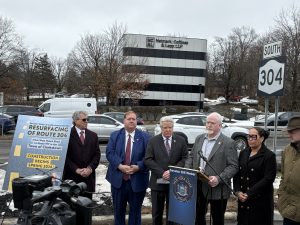
Nanuet, NY – A $16 million repaving project on State Route 304 is scheduled to begin this spring, according to an announcement Thursday from state Sen. Bill Weber, joined by Clarkstown Town Supervisor George Hoehmann, members of the Clarkstown Town Board, and Rockland County Legislator Will Kennelly.
The New York State Department of Transportation plans to carry out a milling and resurfacing project along Route 304 from the pavement joint south of West Nyack Road to U.S. Route 9W. According to the announcement, construction is expected to take place during the spring 2026 construction season, with overnight work intended to reduce disruption for drivers and nearby businesses.
The project addresses a stretch of road that local residents and officials have said has needed attention for years. Concerns have included potholes, uneven pavement, and broader safety issues along one of the county’s well-traveled north-south routes.
Weber said the repaving follows repeated requests from constituents and local officials for improvements to the roadway. He said his office had advocated for the project over several years in discussions with state transportation officials.
“For years, residents have raised concerns about the poor condition of Route 304,” Weber said in the announcement. “The potholes, uneven pavement, and overall safety of the roadway have been a constant complaint.”
He added that the project is intended to provide relief for the many drivers who use the corridor each day.
According to NYSDOT, the work will include more than a new top layer of asphalt. Plans call for milling the existing road surface and applying an asphalt overlay. The project will also include targeted concrete repairs, monitoring of drainage conditions, restoration of pavement markings, and installation of audible roadway delineators designed to improve safety.
Audible delineators, sometimes used as a lane-guidance or warning feature, can help alert motorists when they drift from their lane or approach roadway edges. Drainage monitoring is also a significant part of resurfacing work, since poor drainage can shorten the life of a newly paved road and contribute to future deterioration.
The announcement did not provide a specific start date or projected completion date, but said work is expected to begin in the coming weeks as part of the spring construction season. Overnight scheduling is commonly used for busy road projects in order to limit congestion during daytime travel hours.
Route 304 serves as an important connector for commuters, local businesses, and emergency services in central and southern Rockland County. Its condition has been a recurring topic in local transportation discussions, particularly as residents have pointed to wear from frequent traffic and seasonal weather damage.
Weber said the project reflects what can result from sustained pressure on state agencies to address local infrastructure problems.
“We pushed for this project because our residents deserve safe and reliable infrastructure,” Weber said. “Route 304 is finally being paved, and I am proud that our advocacy helped make this $16 million project a reality.”
The senator also used the announcement to point to another major transportation investment in the 38th Senate District. He cited a separate $9 million improvement project on Route 303, running from Al Foxie Way to Route 9W in the towns of Clarkstown and Orangetown. That project is already underway and, according to the announcement, is expected to be completed by next winter.
Together, the two projects represent $25 million in roadwork investment tied to heavily used corridors in Rockland County. Local officials have argued that such improvements are important not only for traffic safety, but also for economic activity, since deteriorating roads can affect travel times, delivery routes, and access to commercial areas.
Hoehmann, Kennelly, and town officials appeared with Weber for the announcement, underscoring the local significance of the Route 304 work. While the statement centered on the senator’s role in advocating for the project, the planned construction itself will be carried out by the state Department of Transportation.
Weber said he expects infrastructure needs in Rockland to remain a priority.
“Safe roads are not a luxury — they are essential to our daily lives, our local economy, and the well-being of our community,” he said. “I will continue working with state and local partners to ensure that Rockland County receives the infrastructure investment it deserves.”
For motorists who use Route 304 regularly, the coming construction season is expected to bring temporary inconvenience, but also long-awaited repairs to a roadway that local officials say has been in poor condition for years.